
 Bucharest is a city breathing history and lays at the feet of the desirous tourist to see new places a multitude of possibilities to build up itineraries. Less known by the traveler accustomed to discover the urban world, the archaeological sites represent tourist attractions deserving to be visited and promoted.
Bucharest is an area with a great abundance of such sites waiting to unfold their tale. And since I would like to persuade you that tourism means also something else than just spending time in the pubs in the Old Center, I propose to you that we would discover together vestiges in the capital of Romania. For today I have chosen two points on the city map: Biserica Sfântul Nicolae Udricani / The Saint Nicholas Udricani Church and Biserica Trei Ierarhi Colţea / The Three Hierarchs Church Colţea.
The choice made has no religious connotation. We will not relate to these places of worship only as prayer sites, but we will discover another side, the historical one.
Udricani, the Church Guarded by Fig Trees
I left for Udricani from some place in the Old Center. I chose to go on foot and thus I had the opportunity to pass through the square in which Biserica Sfânta Vineri / Holy Friday Church stood erect at one time, and where nowadays there is only a shrine reminiscent of the demolition performed in 1987 by the Communist regime. I headed down toward the old Jewish neighborhood, and I had a few moments’ respite in the “Piaţa Leul Ierusalimului / The Jerusalem’s Lion Square.”
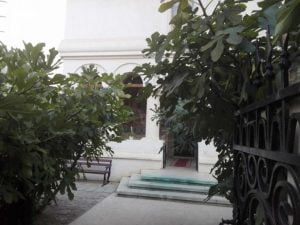
Sitting on a small bench under the shade of a tree already clad in the colors of the fall, I admired the building “Academician Nicolae Cajal.” But, since I proposed myself to dedicate another day to the Jewish influences in Bucharest, I kept walking on my way and, a couple of steps away, next to the Jewish Theater, I discovered, hidden among the other edifices in the area, a gorgeous little church. What led me toward it was the sound, since I was hearing on the background a quire intoning Christian hymns. Flanked by two fig trees laden with fruits, the gate was alluring you, open, to pass over its threshold and to get into the world of “jupânul Udrecan clucer / Lord Udrecan the Supplier.”
Sitting at a table placed within the church porch, a nice lady was reading. The visit that was paid to her did not surprise her, having being used to wandering travelers straying from their path also to Udricani. From the outset, she mentioned that the Reverend is at the Faculty, where he teaches courses, but that the worship place is open to all those who would like to see it.
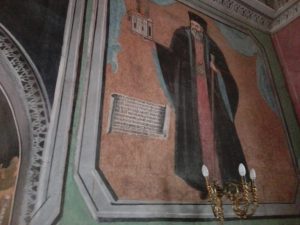
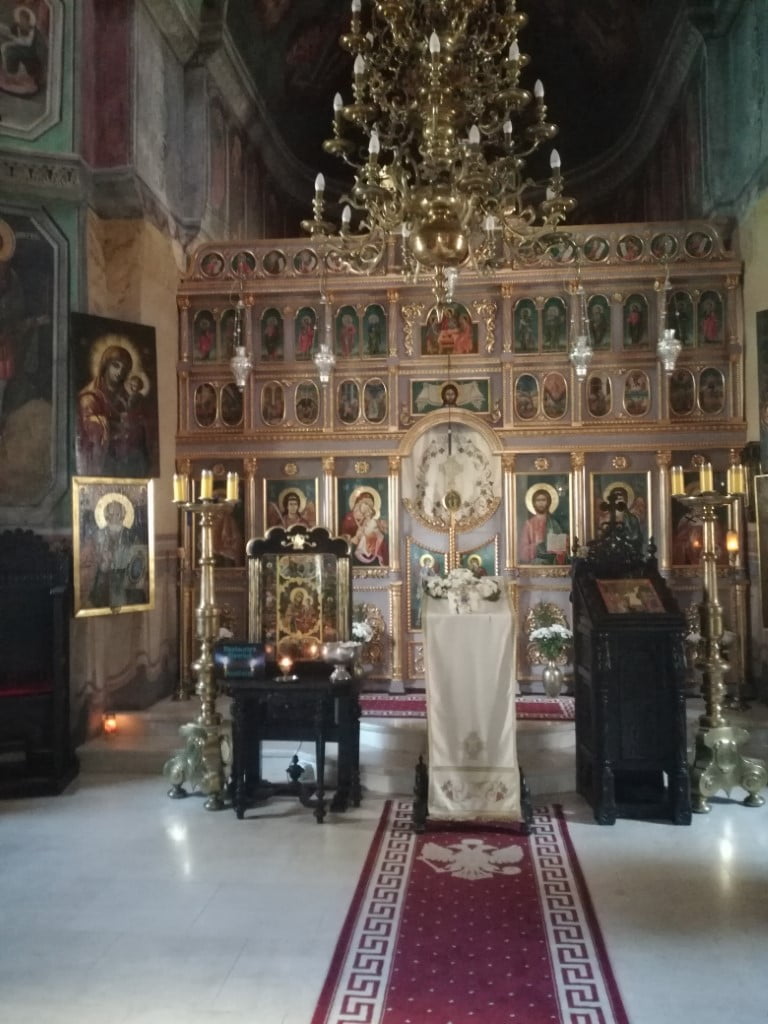
I got into the church and I have to confess that a feeling of serenity has enveloped my soul. The serenity was springing out of the joy of seeing so much history in one place. The painting on the walls of the church is possessed of a special energy even for the one who perhaps doesn’t know that the historical sources indicate that this worship place was ennobled, at its erection, by the “icon painters” under the direction of Pîrvu Mutu’s School, the one whom Christians know today as Saint Pafnutie (The Painter). The painting is performed in 1736, so its performing was assigned to Pîrvu Mutu’s disciples, about whom it is known that he died in 1735. But knowing that you step into a place in which at one time were heard the steps of men of such worth thrills you unwittingly. And as I was standing in the church, it seemed that, somewhere far away, the voice of Anton Pann was heard, singing along with the ones in the quire, and Petre Ispirescu was reeling fairy tales. The place is possessed of a special magic, due to its extraordinary history.
The Treasure Behind the Church
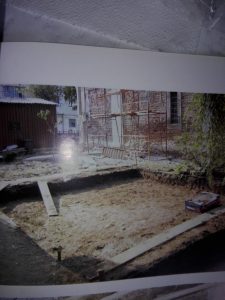
During the documenting that I have done before setting out on this journey, I found out that at the Udricani Curch there is an archaeological site of necropolis type where, allegedly, there are the oldest crosses in Bucharest.
The lady that was my guide throughout the church directed me to look for Priest Prof. Dr. Constantin Pătuleanu, the one who is in charge of this edifice. I received the business card of the Reverend, so I realized that I will have to come back to Udricani after talking to him.
Coming out of the church, I realized that somewhere at the rear part, on the right, there is a great construction site opening. My whole attention was directed toward that place.
Subsequently I would find out that the diggings were started back in 2005, when Reverend Constantin Pătuleanu received the blessing from his hierarchs to become responsible for the parish, as well as the explicit charge to save the church, that was in an advanced state of degradation. Along with the worship place, the Reverend was given the commission to recover the whole heritage of the Udricani Parish, more precisely the land plot and the Ecaterina Nursing Home, built on this ground by Archpriest Teodor Economu. The land plot and the building have been abusively taken over by the state after the year 1945.
By the support of the parishioners, and with a group of passionate people, the Reverend set out to do the job, but, in the own words of his highness, from the very first strike of pickaxe, it became clear to everyone that the place is much more than just an Orthodox worship place. And when the second and third strike was applied, the pickaxe went down much more carefully toward the ground. The decision was made that it was much better to do the digging around the places where the obstacles emerged. Thus, an archaeological site in every sense of the word was opened.
The archaeological research was carried out under the coordination of Gheorghe Mănucu-Adameşteanu, who, following the diggings performed, discovered both within the worship place, and also around the church, a real treasure. In this project of such an importance, the archaeologists did not work by themselves, but were joined by historians and architects.
Following the analyses performed both on the masonry elements and on the objects unearthed by the archaeological diggings, it was concluded that the church was erected on the site of another much older church, probably made of wood and with a foundation made of bricks.
The experts’ work resulted in unearthing 130 gravesites, either whole or disrupted, as well as 48 crosses (whole or fragmented). Furthermore, a number of coins, ceramic fragments, but also entire ceramic vessels, seal rings and numerous other objects were found. The analyzing and age determination performed on these objects entitle the researchers to presume that in this place there was a church with a graveyard being formed around it, as early as the 17th century.
For instance, the oldest coin discovered is a Polish Grosch issued during the reign of King Cazimir (1444-1492) of Poland, and the most recent one is a coin of 2 Kreutzer (crăiţari, n/t: an old Austro-Hungarian coin). And even though in that era the coins were circulating a long time since the date of their issuing, the hypothesis is still maintained that the settlement is older than it was thought initially.
The Graveyard Has Been Buried Under a Load of 153 Horse-Wagons Filled with Soil
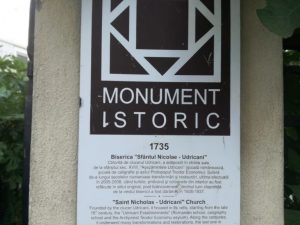 Over the old graveyard, another one was formed in the year 1735. Surprising for a slum graveyard is the very great number of the stone crosses, much greater than in other sites of this kind in Bucharest. But we can find an explanation as a result of a number of actions undertaken during the rule of Alexandru Ioan Cuza.
Overtime, just as it happened to the slum, the church knew periods of prosperity and decadence. Fires, earthquakes, urbanistic works, all led to the transformation of the place. There were also restauration works more or less appropriate, some inflicting more damage, affecting the main building and disturb the gravesites.
But the most brutal intervention takes place during the time of Alexandru Ioan Cuza, who in 1864 will give orders to the effect that the graveyards would be dislodged from the city and be moved away to the periphery of the capital. A law was promulgated and thus the dead left once again, and made room for the living.
In the case of the Udricani Church, it seems that the responsible persons did not dislodge the gravesites from here. The gravesites remained, but were buried under a load of 153 horse-wagon filled with soil, and were hidden along with all the crosses keeping vigil at the head of the dead.
The last urbanistic converting of the area, the one during the 7th-8th decades of the 20th century (the one initiated during the Communist period) affected the area profoundly and beyond repair, many monuments and vestiges being permanently lost.
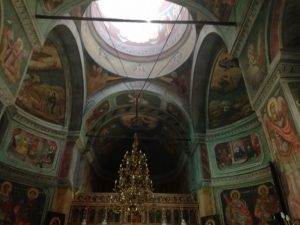
But still, today, there are great chances that the Udricani Church would come back to the forefront of history, as it was during the time in which a real Romanian school was developing here. And one step in that direction is represented also by its promotion as an important tourist attraction for the person passionate about religion, but also for the one eager to discover the history of these lands.
As regards the church, it is known that it was built “about 1734, at the time of the first rule of Grigore II in Ţara Românească / Wallachia” and was dedicated to the Saint Hierarch Nicholas of the Mira of Lichia.
“This holy and divine church was made, with all its expenditure and adornment, as it can be seen, by His Highness Lord Udrecan the Supplier, he being filled with the divine zeal unto the extolling and glory of God and of the great Hierarch Nicholas, and for his and all his generation’s eternal remembrance. And it was performed during the days of the magnificent Lord of the whole of Ţara Românească / Wallachia, I, Prince Grigore Ghica, the Metropolitan High-Priest being the Most Holy Lord Stephen in the year 7244 from the foundation of the world, and 1734 since Christ, in the month of September, day 15th” – bears witness the inscription over the entry door into the church.
The Mediaeval Gravesites at Colţea
I left the area and headed toward another place about which I had learned that was a necropolis type of site. I went up the Corneliu Coposu Boulevard, I passed again through the Piaţa Sfânta Vineri / Holy Friday Square, and headed toward the Unirea / Union area. I got past Biserica Sfântu Gheorghe / Saint George Church and I stopped at the Biserica Trei Ierarhi / Three Hierarchs Church – Colţea. I enjoyed for a few moments the architectural beauty of the building, a representative historical monument for Bucharest. My aim, though, was the archaeological site over here, where the researchers’ works unearthed 108 mediaeval gravesites, arranged along the three of the sides of the church.
As in the case of the Udricani Church, comprehensive works of restauration were performed, accompanied by archaeological researches. Actually, in the Colţea case, the first gravesites were unearthed even during the Communist period (between the years 1958-1970), when Archaeologist Dinu V. Rosetti researched the site. After 1989, the restauration works at the church are resumed, and on this occasion the archaeologists intervene as well, succeeding in discovering other mediaeval gravesites.
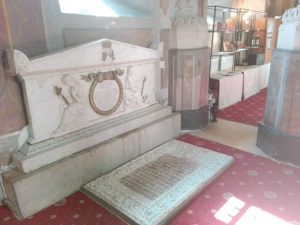
Archaeologist Gheorghe Mănucu-Adameşteanu coordinated the researches carried out at Colţea as well, and following the diggings, 127 mediaeval gravesites were unearthed, but also the foundation of the old church.
The funerary inventory made by the archaeologists includes Western and Ottoman coins, laid ritualistically within the gravesites, but also adornment objects, such as rings, earrings, buckles. Within the researched gravesites were found also metal buttons, and the historians concluded that in this graveyard were buried militaries as well. Moreover, there are bricks with inscriptions that were found under the skulls in certain gravesites, inscriptions that make reference to the fact the defunct was of a noble origin.
The discovery of the two archaeological sites of a necropolis type, the one at Udricani and the one at Colţea, presents us with the history of Bucharest and provides us with information about various periods in the life of the city.
Because of these vestiges existing on the territory of the capital, the historical tourism can develop and can become a constancy in the itineraries of both Romanians and foreigners coming over to visit Bucharest.


