
 As I advance further in my endeavor to discover Bucharest, I realize that in front of my eyes a fascinating world opens up, which unwittingly, I ignored far too long. It is the troubled story of a city exhibiting its soul with a remarkable sincerity before the one attempting to see Bucharest for what it really is: a city with an impressive past, a city having nothing to be shamed about among the other world metropolises, a city having a multitude of things to convey.
Of the wealth of vestiges in Bucharest, today we chose to visit a place that is closely connected to the history of Catholicism. Being deprived of any religious connotation, our endeavor has no other intention than bringing to the spotlight a touristic objective the capital of Romania includes and that can be part of the itinerary of the one who wants to discover the historical Bucharest.
This time, the tourist among vestiges stops over at the “Bărăţia” Church, the oldest Catholic Parish in Bucharest.
The Multi-Century Long History of “Bărăţia” Church
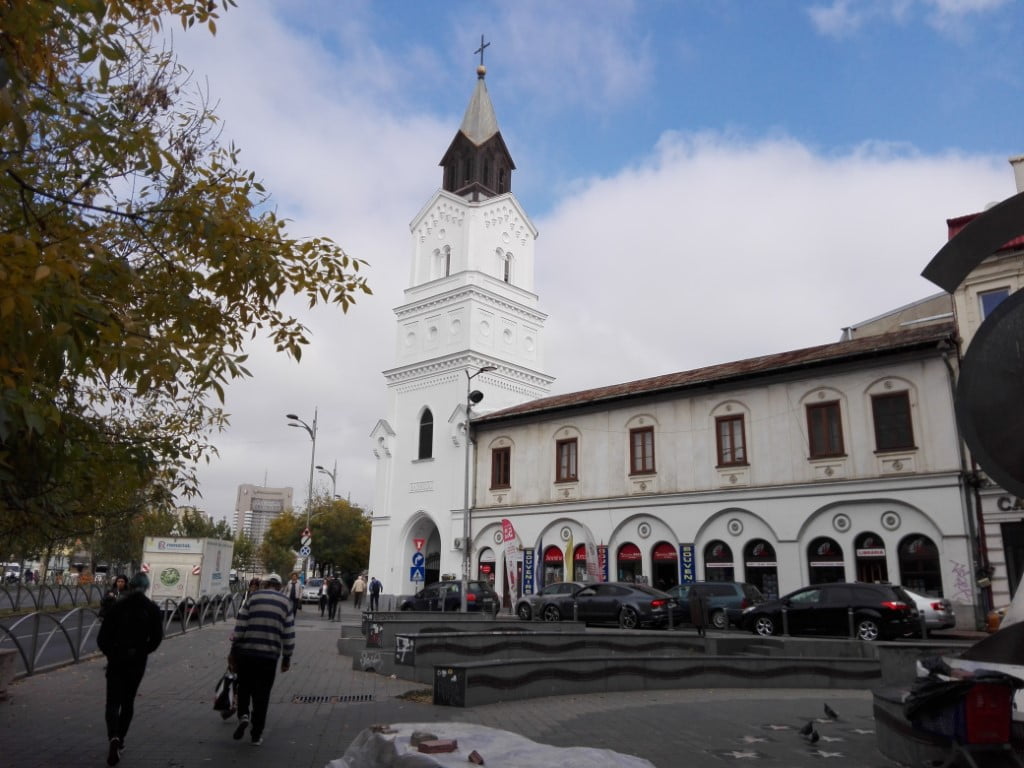
Positioned right in the center of the city, on I.C. Brătianu Boulevard, the Sancta Maria Gratiarum Parish, known among the Bucharestians as “Bărăţia” Church, is rising loftily in front of the passerby heading toward The National Theater. The perfect white of the building incites you to stop by and want to find out the history of this place. The Church’s bell-tower keeps vigil from its height over the city which is its home.
It is a place heavily laden, a place unveiling a tale stretching over a number of centuries, a tale of a worship place who knew all the great tragedies of the lands on which today we find the capital of Romania.
The “Bărăţia” Parish has its roots somewhere faraway in the past, having been established in the year 1629. It is the first Catholic worshippers’ location in this part of the country.
Having behind such a heavy historical load, there is no way the Church would not cause you to want to discover it. That is exactly what we have done. Accompanied by my colleague, one Thursday we stepped in beyond the gates guarding the entry into the “bărăţie” (editorial note: a church or a cloister, a distinctive name given to the Catholic worship places in the cities located East and North of the Carpathians). We got into a courtyard in which a couple of workers were keeping themselves very busy working on one of the constructions inside.
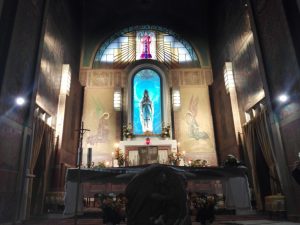
The church’s door was wide open, so we climbed up the few stairs and got into the worship place. The dim light on the inside was offered only by the sun rays making their way through the impressive stained-glass works decorating the church’s windows.
Later I was going to find out that the stained-glass works of “Bărăţia” were manufactured in a specialized workshop in Bucharest, on two of them the name of the donor being entered: M. Ziegler, 23 Schitu Măgureanu Street. Unfortunately, there is no date as well to certify to us the period in which these stained-glass works emerged.
The stained-glass works are divided up into four pairs covering the windows, placed on either side of the church’s walls. On the left side, toward the altar of the worship place, stand guard: “The Most Holy Heart of Jesus,” “Saint Anna with the Holy Virgin,” “Saint Dominique Receiving the Rosary from the Holy Virgin,” and “Saint Edward, King of England.” On the right side, other four stained-glass works stand out: “Saint Joseph,” “The Immaculate Heart of the Holy Virgin,” “Saint Augustin,” and the last stained-glass work represents “Saint Michael the Archangel Pushing Out Lucifer.”

At the entry of the church also were located, at one time, two stained-glass works representing Hoy Apostles Peter and Paul, but the footprints of time have made themselves felt, the colors being faded. Today, behind these two stained-glass works there is a wall making it virtually impossible to distinguish the two saints.
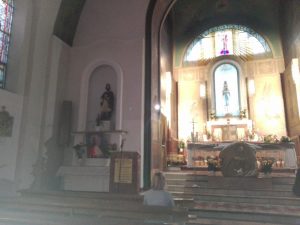
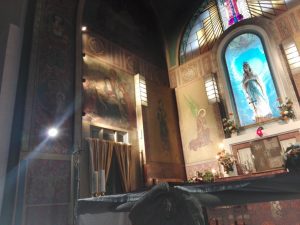
I must tell you that, while I was admiring the spectacular construction inside the Church, two ladies were silently praying in a corner. Slightly bent over the benches’ seatback in front of them, the women were keeping their hands gathered on their laps, penciling the tender picture of a man come to find his serenity in a place where he believes he can feel closer to God. Their sight was directed toward the altar, the place in which statues may be seen, but also mural paintings representing various Biblical figures. The worship place perfectly combines the spectacular character of the old stained-glass works with an interior constructing an image distinctive to the Art Deco Style.
As I was admiring the fascinating beauty of this place, one of the employee-women of the “bărăţia” approached us, offering to us the necessary instructions to find the church’s parish priest. We embarked on a quest for the person who could speak to us about the history of Sancta Maria Gratiarum Parish. He was in one of the buildings inside the “bărăţia.” He was working shoulder-to-shoulder with the workers.

A man possessed of a modesty that can rarely be encountered nowadays, the parish priest Cristinel Ţâmpu seemed rather surprised that we chose to bring to the readers’ attention the very worship place he is pastoring.
He joyfully led us through the church, and in order to allow us to see all its magnificence, he lit up all the lights within the worship place. He graciously offered us a present: the Monography of the “Bărăţia” Church, a literary work coordinated by the former Parish Priest of the worship place, Priest Dănuţ Doboş.
Time and Again, “Bărăţia” Has Been Reborn of Its Own Ashes
As I also mentioned previously, the Parish has been established in the year 1629, but the church we see today has passed a number of times through the flames of destruction, managing to stand through the centuries and every time be reborn out of its own ashes.
The few historical resources indicate that on the spot where today “Bărăţia” is rising, the first Sancta Maria Gratiarum Parish was constructed, somewhere in-between 1631 and 1633. The wooden Church “measured ten steps in length and five in width, i.e. approximately 30 square meters.” The work was so poorly performed, that within less than even 40 years, only the ruins remained of the first “bărăţia.”
But still, the church will be reborn after the year 1716, when the documents kept until today speak about the construction of another worship place instead of the wooden one. It looks like the works have begun ever since 1672, but the historical circumstances were hostile and did not allow their completion. The building up of the second “bărăţia” was completed somewhere around 1741.
But over this place the flames of a great blaze will befall, a blaze which, in the afternoon of August 28th (September 9th) 1804, starting out from the Şelari / Saddlers slum, turned into ashes “Bărăţia” as well.
Again, the Catholic world in Ţara Românească / Wallachia needed to make efforts to gather the necessary funds for the reconstruction this Parish. And thus, in the year 1813, we will have the third “Bărăţia” completed.

But history will repeat itself much faster than anyone could anticipate, the third “bărăţia” standing up for only 34 years. On March 23rd 1847, a day which it is said to be the Palm Sunday for the Orthodox Church and the Easter for the Catholic Church, it proceeds from Dealul Spirii / The Spirii Hill a strong blaze that will turn into ruins and ashes the whole Western half of Bucharest. “At ‘Bărăţia,’ everything was burned down to the foundations, Church, Cloister and Tower alike; in the fury of the fire, nothing could be saved.”
Luckily though, during that period of time, the influence of the Imperial Court of Austria was rather great, so that the donations done by it will constitute the foundation for the remodeling of the “Bărăţia” complex. The works will be completed in the year 1850, and the Parish will operate in this manner, including during the period between the two World Wars. “The remodeling after the fire in 1847 was made by stamping a local character, a Romanian one, on the “Bărăţia” ensemble, breaking out of the Catholic traditional patterns. The bell-tower was constructed, on the entry side into the cloister, apart from the Church, and on the Western façade of the Church a tower in Baroque style was erected. Likewise, at the base of the semicircular apse, a similar little tower was erected, so that it would imitate a closeness to the style of the Orthodox Churches, that are possessed of a tower on the narthex, and a vault in the middle…,” records Dănuţ Doboş in the literary work “The ‘Bărăţia’ Church – Bucharest. Four Centuries of Spirituality.”
The Fire is Being Replaced by the Bulldozers
“Bărăţia”’s turmoil is restarting during the year 1933, when Bucharest General City-Hall systematized the great Boulevard I. C. Brătianu. And instead of the flames consuming this worship place during a number of episodes, the bulldozers show up, crumbling to pieces a great part of the edifices of the Parish complex. “On that occasion, the old Franciscan cloister was demolished, including all the related facilities, as well as the old cells on the Northern part of the “Bărăţia” tower, the complex acquiring its nowadays form,” recalls Dănuţ Doboş.
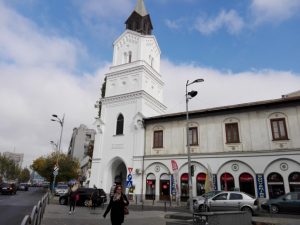
The Communists were too delighted either of the fact that in the middle of “the capital of Romanian Socialism” thrones a construction so heavily laden religiously. The even tried to take advantage of the disasters inflicted by the 1977 Earthquake on the edifice, and to force a demolition thereof. Only the courage of those who pastored the Church at the time caused the then authorities to give up the idea. The salvage of “Bărăţia” came from the ingenuity of Monsignor Francisc Augustin, who presented “Bărăţia” as “a component of the urbanistic landscape of the capital difficult to replace, as well as one of the few obvious milestones of the North-South Axis of the city.” Furthermore, he insisted on the fact that it represents a Bucharest “major point of touristic attraction.”
This endeavor was successful among the Communists who got involved in repairing “Bărăţia” after the damages inflicted by the 1977 Earthquake. The works were endorsed by the very Ion Dincă, the then Mayor of the capital, who visited “Bărăţia” and ordered rehabilitation works.
And today “Bărăţia” stands guard over the I.C. Brătianu Boulevard, concealing behind its white walls the troubled history of the city of Bucharest.


