
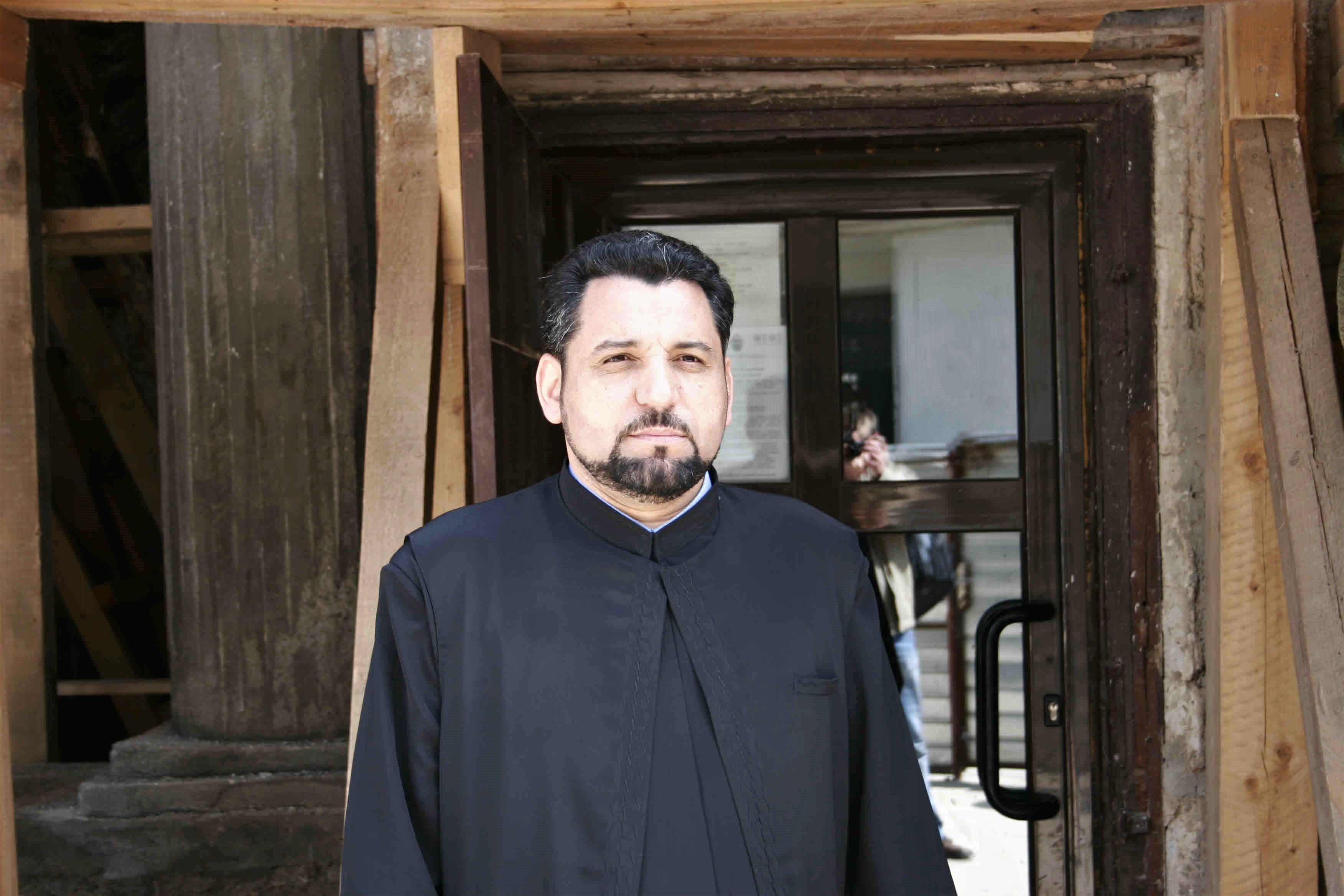
 Priest-professor Constantin Pătuleanu, PhD, the parish priest of the Church of Saint Nicholas of Udricani, is fully involved in the promotion and salvation of the cultural heritage of Bucharest. Through his actions, the priest-professor proves that, for the church, the ministry of the liturgy is inextricably linked to the educational and social-philanthropic undertakings.
For many years now you have been in charge of the Church of Saint Nicholas of Udricani. What is the place of this monument of worship in the history of Bucharest? What message does this building convey to us about the Bucharest of the past?
Udricani Church, with the dedication to “Saint Nicholasˮ, was built by Clucerul Nicolae Udricani, together with his wife, Clucereasa Maria, in 1734. The church is located on Clucerul Udricani Street, which intersects with Clucereasa Maria Street. If the first dedication of the Church is “Saint Nicholasˮ, the second dedication is “The Assumption of the Virgin Maryˮ. It is obvious that the two founders have carefully chosen the protectors of the holy place.
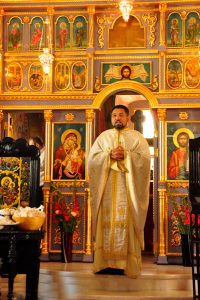
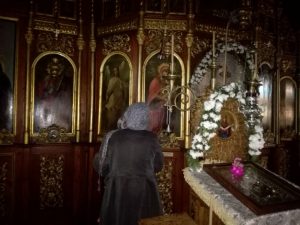
In the church, there is an icon of “Saint Nicholasˮ that is intact, only bearing the obvious signs of the great fire in Bucharest, of 1847, when many houses and churches burned down. As a result of this unbelievable miracle, believers worship this Holy Icon as a miracle.
In the church, there is also a large icon of the Mother of the Lord “Platytera ton ouranon”, unique in the country, dating from 1885, probably painted at Mount Athos, to which faithful people worship, belittled with piety at its readily helpfulness.
Recently, our church has also received a fragment from the remains of Saint Anastasia the Great – Pharmacolitria (the Healer), as well as a fragment from the relics of Saint Anastasia the Roman. The cult of Saint Anastasia was brought to the Church of Udricani by Bishop Timothy Troados, who re-founded the church after the “Great Fireˮ (1847).
The church has special history, as it was built in “Popii Isac slumˮ, in an orchard of apple trees, pear trees and mulberry trees, then located on the outskirts of Bucharest (near the Bucureștioara River, extinct nowadays). Soon, a school of calligraphy and the Romanian School from Udricani were set up here, where teachers such as “Chiosea, Chiriță or Stanˮ and later the teacher of the church Nicolae, gathered children, at first, in the church porch and at the church pew, to learn to “read the letters and hold the isonˮ, instead of roaming the streets.
Ion Ghica wrote the following about this school: “Around the church, in the slum, among orchards of apple trees, pear trees and mulberry trees, there were about ten to fifteen roofs with eaves protruding like umbrellas, under which there lived some shoemakers, tailors, hatters and furriers; when they went to their workshops, they would send their children to teacher Chiosea, so that they don’t roam the streets and he teaches them how to sing, hold the ison of the singers in the pew, read the Acts of the Apostle, recite The Lord’s Prayer and the Act of Faith Prayer …ˮ Teacher Chiosea was the one who taught famous people like Logofăt Greceanu, the boyars of the Văcărești family, Anton Pann, Paris Momuleanu, Petrache Nănescu, Marin Serghescu, N. Filimon etc. to read and write. [Ion Ghica, Scrisori către V. Alecsandri (Letters to V. Alecsandri), Editura pentru Literatură (Publishing House for Literature), 1967, p. 47].
From such schools, many church priests and church singers were recruited: Chiru – from the Church of Enei; Dumitrache Bondoliu – Father of the Bishop Calistrat; Unghiurliu – from Sărindar; Costache Știrbu – from the Church of St. John Near the Prison (?) and Petre Efesiu, singer in the right pew at the Patriarchate; Nicolae Alexandrescu who was raised to the rank of a cafegi-bașa (a lower rank boyar who would bring the coffee to the prince of the country during ceremonies) at the court of Grigorie Ghica; Marin Sergescu, a nationalist, imprisoned together with N. Bălcescu, Mitică Filipescu and Telegescu; in fact the last of this list was even called “Marin Naționaluˮ (Marin, the nationalist) [Ion Ghica, Scrisori (Letters), p. 50].
Not far from Udricani Church the writer Petre Ispirescu also lived. He was certainly a disciple of the Udricani school.
The year 1877 is special in the history of the church, because this is the year when the Dean Teodor Economu started building an Asylum for the Elders, right in the church yard. Here 25 widows were housed after the War of Independence of 1877.
Emil Pache Protopopescu, a successful lawyer and mayor of Bucharest at the beginning of the twentieth century, was appointed the asylum curator after the death of the Dean Economu. As mayor, he signed a protocol between the town hall and the asylum, offering 20 lei to each widow in the asylum.
Thus, the asylum functioned until 1950, when it was taken over by the state. The widows were evicted and the apartments remained vacant were rented. Only in 2005 did we manage to obtain the restitution of these settlements to the Parish of Udricani. Unfortunately, the settlements were in such an advanced state of degradation, as no maintenance work was done for 65 years, that we had to abolish them.
Currently, the Udricani Parish has begun the reconstruction of the Romanian School from Udricani. The new project involves the creation of modern educational spaces, from kindergarten and gymnasium to high school. Eight hundred children will be able to study here.
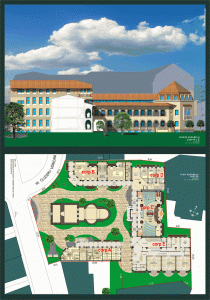
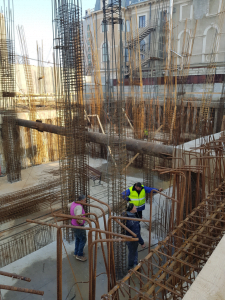
So far, we have managed to cast the foundations and erect the side walls of three of the five buildings of the project.
It is worth mentioning that the General Administration of the Municipality of Bucharest has so far provided important financial support and we hope that we will be further assisted in our efforts to carry on with the exceptional educational and social activities carried out by Udricani Church over time.
I related all these in order to have people understand that Udricani Church, 300 years old, carried out its activity along three fundamental aspects as regards the reason for its existence in Bucharest.
As a sacramental landmark, it was close to people from Bucharest through the services and prayers raised here. As for education, it was an example of dedication and sacrifice in the education and enlightenment of children and young people of Bucharest, many of them honoring the Romanian people and culture. As far as the social aspect is concerned, through the Economu “Asylum for the Elderlyˮ, Udricani church has proved to be an exceptional philanthropic institution, especially after the War of Independence (1877).
Through all these activities it is clear that, for the church, the ministry of the liturgy is inextricably linked to the educational and social-philanthropic ministry.
The excavations made around the church have revealed a true archaeological treasure. What stage are the works at the archaeological site near the church at? What stage is the renovation of Udricani Church at?
The archaeological site at Udricani was closed following the completion of the works. Following the discoveries made in 2011, a volume was published containing a rich documentary and photographic material on the history of the church, data on archaeological discoveries, tombs, funeral stones, coins etc., as well as many elements regarding the Romanian School of Udricani.
Why should the tourist come to see the Church of Saint Nicholas from Udricani? What distinguishes this church from other places of worship? What’s special about it?
Pilgrims and tourists who will head to Udricani Church will be rewarded in various respects.
They will be able to share in the spiritual richness of a place of worship that for nearly three hundred years has sanctified the lives of believers through the holy services performed here. For many years, the church functioned as a monastery.
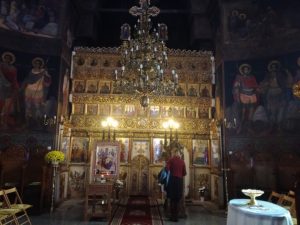
The beauty of the church will delight people who love the harmony, measure and architectural proportion of the post-Brancovan architectural style. Also, the mural paintings in the porch will transpose the viewer into the golden age of the Romanian painting represented by Constantinos’ school and later by Pârvu Mutu.
The interior furniture, although recently executed by the sculptor Dumitru Gârea, will remind the viewer of the epoch of the authentic Brancovan sculpture.
The atmosphere in the church, its peace and tranquility will inspire the faithful pilgrim or the simple tourist to introspection and meditation, to prayer and contemplation.
Those burdened by restlessness, suffering or sin, those troubled by the great storms of life will be able to find here peace and soul balance, when kneeling in front of the icons of the church and of the holy relics of Saint Anastasia – the Healer.
Many of the churches in Bucharest are places that can integrate perfectly into the route followed by a tourist passionate about the history of these regions. What measures should be taken to ensure that all this wealth of historical monuments is maximized and made more widely known?
The enhancement of the monuments in the center of Bucharest requires a more sustained effort on the part of the General Administration, on the part of the mass-media of Bucharest, on the part of the tourism companies and of course on the part of the churches. Everyone must try to make known, by the specific means of each institution, the history of these monuments, their spiritual load and their artistic wealth.
Can you recommend us five other churches in Bucharest that tourists who are passionate about history or pilgrims looking for peace of mind should visit? Why did you remind only the above places of worship?
Negustori Church ( “Sfântul Nicolae” – Negustori Church, located in Rosetti Square, in 5, Teodor Ştefănescu Street – note of the editor), Trei Scaune Church (Three Chairs Church) – behind Colțea Hospital, the Holy Trinity Church in Calea Moșilor, Răzvan Church in Calea Moșilor, Colțea Church (or the Three Hierarchs – Colțea Church, our note). All these churches are close to each other and were build during the eighteenth century, the golden age of architecture and mural paintings, also called the Brancovan style age.
Bucharest is a city where history mingles with modernity. How could we better value the city’s heritage so that we can maximize it?
All the responsible factors, and I would list here: mayors, government, NGOs and private companies, should invest more in preserving and promoting these priceless values of the Romanian spirit – the historical Church monuments.
Are the young generations concerned with the preservation of history and with finding solutions for a better exploitation thereof?
Especially the young people who have training in the field, I refer to people who have attended or are attending art school courses, are interested in saving the cultural heritage of the country. Otherwise, I think that the new generations of young people should be helped to better understand the values, traditions, and monuments of art. In this way, they will value, keep and promote them further.


