
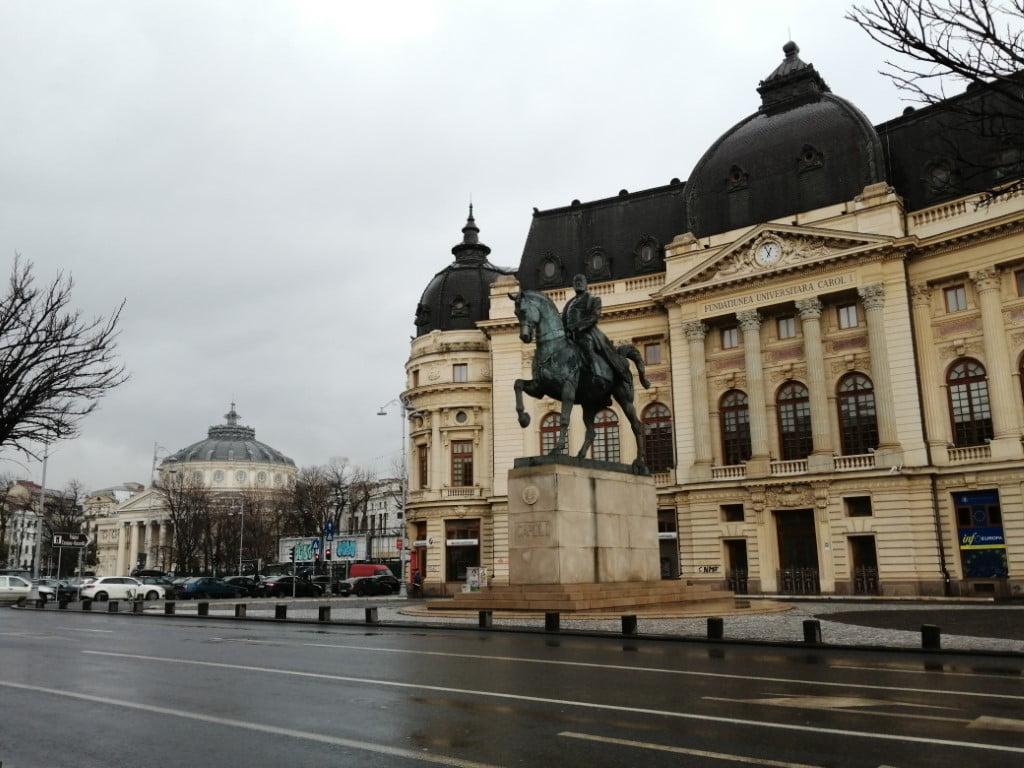
 The fragrance of “La Belle Epoqueˮ is still felt today in Bucharest, where the mixture of architectural styles gave birth to a unique city in Europe. The period known in the history of humanity as “”La Belle Epoqueˮ represented for the Capital of Romania four decades of peace, four decades in which there were many remarkable changes in all areas.
We will go to the beautiful epoch of Bucharest to discover symbols of those times that we can admire even nowadays.
The atmosphere of “La Belle Epoque”
We begin our journey from Calea Victoriei, which is said to exemplify in the most eloquent way the modernisation of the city after the moment it became the capital of the United Principalities of Romania.
To get an idea of what “La Belle Epoqueˮ (The Beautiful Epoch) means, it is enough to walk into the Cantacuzino Palace, the place of the present “George Enescuˮ National Museum.
The building built, between 1901 and 1903, commissioned by the “Nawabˮ (Grigore Cantacuzino) was upholstered with white and green marble, onyx and Cordoba leather. Interior decorations (chandeliers, lamps, stained glass, tapestries etc.) bear the signature of the Krieger House in Paris. Moreover, murals are signed by artists like Arthur Verona or Nicolae Vermont, while sculptures and carved ornaments are the work of Emil Wilhelm Becker.
Another symbolic edifice of Bucharest attributed to the “Beautiful Epochˮ is the Romanian Athenaeum (the construction was achieved between 1886 and1888, Editor’s note).
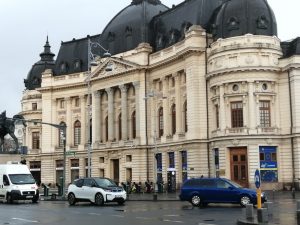
Very close, we come across the headquarters of “Carol I University Foundationˮ, the building of “Carol I Central University Libraryˮ that was erected between 1891 and 1893. The dominant style of this building is “Louis XVIˮ, the decorative symmetry giving a strong note of solemnity, but at the same time also of elegant opulence, accentuated by the luxury that characterizes the interior of the building decorated with stained glass windows, carved oak shelves and leather furniture.
Going further, along C.A. Rosetti Street, at number 8, we find Theodor Aman Museum, a place that transmits today the atmosphere of private life of the respective period. The painter Aman has the great merit of having caught in his paintings eloquent evidence of what happened in Bucharest during the beautiful epoch. The genre scenes he adopts in his works practically “takes photographsˮ of certain events experienced by the artist. “The Evening Partyˮ, for example, depicts the atmosphere of the parties in the Little Paris. The work painted in 1878 is a true document that speaks about how the cream of the society of that time was entertained in those times. Eloquent information can also be found in the paintings “At the Soireeˮ (1874) or “In the artist’s workshopˮ (1883).
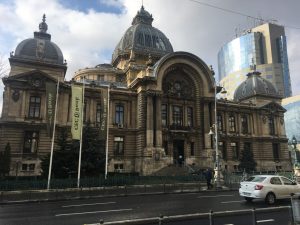
From a presentation that refers to “La Belle Epoqueˮ, the CEC Palace cannot be missing or, as it was initially “baptizedˮ, the Palace of the House of Deposits, Agreements and Savings.
The work of the architect Paul Gottereau, the building was built between 1897 and 1900 and includes many elements specific to 19th century France. The semicircular pediment over the entrance gives a special note to this building. The grandeur of the palace is amplified by the decorations that adorn the facade.
The Belle Epoque symbols in Bucharest are not limited to the buildings on Calea Victoriei. In the Museum of the “Politehnicaˮ University of Bucharest we have found Aurel Vlaicu’s models, sketches and worksheets.
Also, in the north of the Capital, there is a memorial house that reminds us of Victor Babes, a prominent character of those times. The museum, which bears its name, is a place where the personality of the great scholar is present in each of the objects displayed here.
The time of the reign of Carol I
For Romania, “La Belle Epoqueˮ represents, in fact, a period of 43 years during the reign of Carol I. The beautiful era begins in 1871, the year when the War between France and Prussia ends and lasts until 1914, when the First World War broke out. There have been four decades, in Europe, with spectacular developments in the field of science, arts, economy, developments that historians resemble those of the Renaissance period.
For the Romanian society, the age is important due to the fact that many changes occured, especially at the level of the middle-class. It is the period when Romanians from abroad came home and implemented what they had learned abroad.
Compared to what happened later in the history of mankind, it can be said that “La Belle Epoqueˮ meant story times foremostly dominated by peace.


