
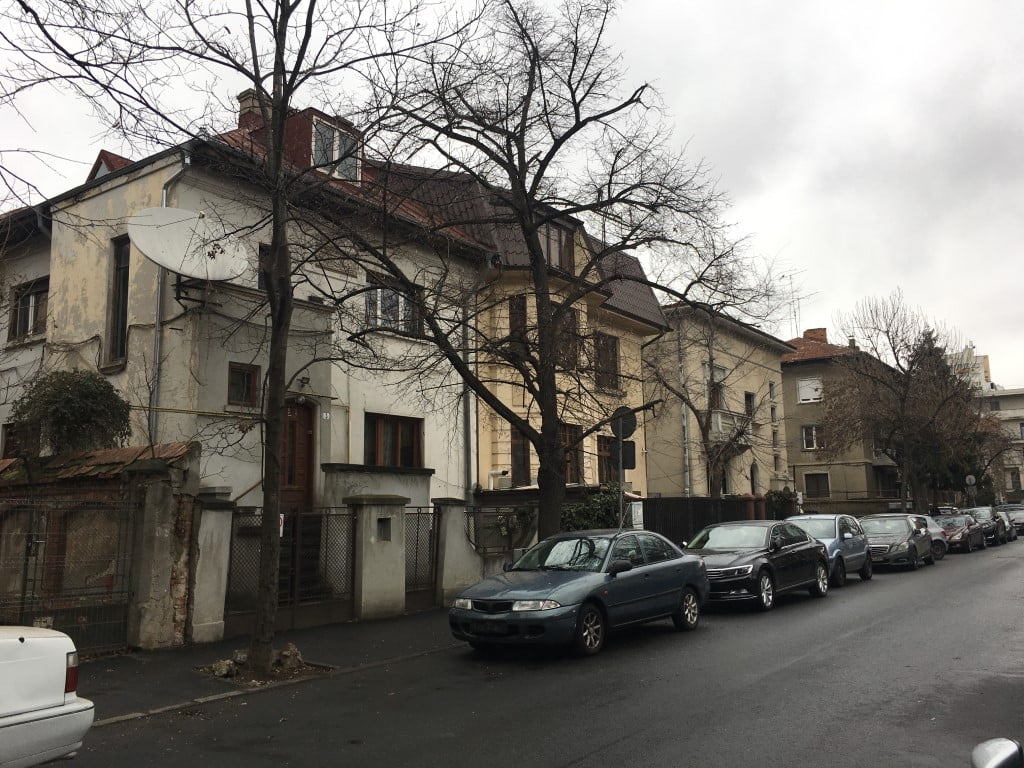
 All roads in the central area of the capital lead to Iancu de Hunedoara Boulevard. From Oslo Street, passing through Finland Street, we returned to this boulevard to look for a new destination. And very close to Oslo is the Bern Street. So for the moment we’ll stop here.
The connection between Bern and Oslo
As in Oslo, the “courtyards” of the building that houses the Treasury of District 1 (building located on London Street) and of the villa on Rome Street number 7, where formerly was the headquarters of the Finance Administration of District 1, are the ones that make up the part of the even numbers of Bern Street.
The charm of this area is much better enhanced on the side with uneven numbers, where we are greeted, with the same eclecticism specific to the area, elegant villas of Neo-Romanian and Neoclassical style. However, we notice an important change in the way architects use the space at their disposal for the constructions they have to perform.
Low fences and reduced vegetation ensure a brightness that allows the display of details and decorative elements, so that the passer-by can admire lacy masonry decorations on the frames of the doors or windows. The simplicity of the constructions is “broken” also by the slightly stylized form of the balconies that adorn the walls of the houses from place to place. It can also be seen that the land is divided between the building and the yard. In this way, each of these buildings benefits from an external space, which is used according to the preferences of the residents.
The interiors of these houses, in which we find apartments that can extend on one floor are interesting too. The rooms are generous, offering multiple possibilities of arrangement. The connections between floors are made by spectacular interior stairs.
The buildings in the area have either two floors plus ground floor, or they are compartmentalized so that the semi-basement is habitable and is equipped with generous windows that allow light to penetrate. In the case of the latter houses, the construction only has ground floor, first floor and possibly attic.
In line with the evolution of the city
But we return to the street, where we have the opportunity to admire again how architecture has evolved over time. Thus, if on many of the streets with the capital’s name we have found villas that are cozy, that only house one family, on Bern Street the buildings that offer living space for at least two or three families dominate. We are already approaching the Dorobanți area, where the high villas refer to what will happen in the architecture of the city, after the arrival of the communists.
The changes that take place in the architecture are in line with the changes that the Capital of Romania is undergoing, with the passing of the years, Bucharest becoming more and more crowded. Under these conditions, the pampering of ground widespread contractions, erected immediately after the First World War, has ceased to exist since 1940.
The mark of the architect Emil Călinescu
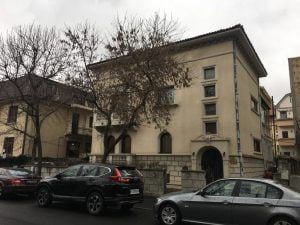
The building at number 7, on Bern Street, was erected in 1946 and bears the signature of the architect Emil Călinescu (1903-1981), the author, among others, of the building that hostes the House of Armenian Culture “H. and V. Dudian” from Bucharest (located near the Armenian Church, on Carol I Boulevard) and of the historical monument villa in Popa Soare Street number 55.
The Armenian architect Emil Călinescu was also involved in the finalization of the plans that were the basis of the construction of the magnificent mansion in which we find today the National Museum of Maps and Old Books. Also, we can see his professional mark in the case of many buildings in Dorobanți area, where he was asked to get involved in the elaboration of the construction plans.
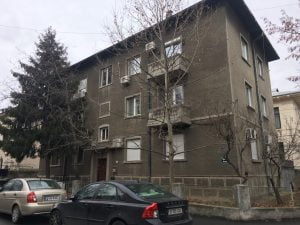
The villa on Bern Street is emblematic for the style that Emil Călinescu has adopted in “civil architecture”. When the services were requested by individuals, he came up with solutions for an efficient use of the land on which the constructions were made. Calinescu carried out the project in such a way that the ground plan of the building did not “bite” too much from the ground, he raised the building and secured it through thick exterior walls.
Bern street is not a long street, which you can walk at will. On the contrary, it ends quite abruptly, immediately after the building at number 9, from a functionalist source, a building that gives a note of sobriety to the area, making the connection with the Rome Street.
We leave Bern behind and head to other capitals of the world.


