
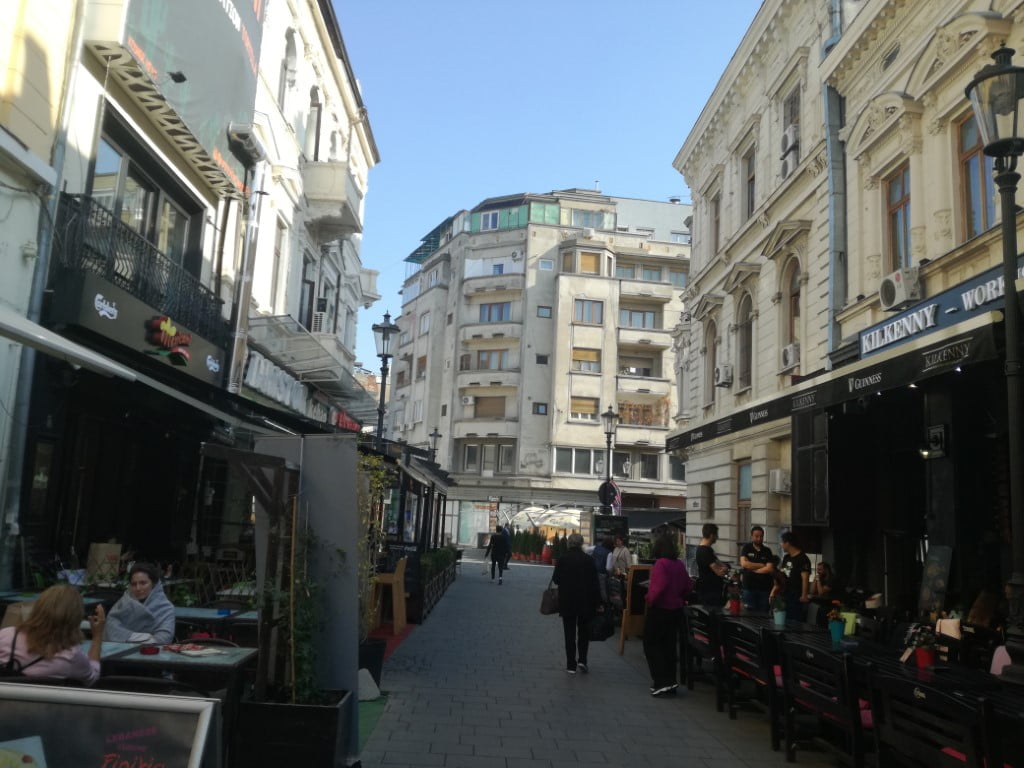
 Houses with walls through which the history of Bucharest breaks out, a tiled alley reminiscent of the period between the World Wars, and plenty of coffee-shops on either side of the road, Strada Franceză / French Street is today a happy blend of old and new, a place which would be impossible for the tourist come to discover the capital of Romania not to want to go through.
Splaiul râului Dâmboviţei / Dâmbovița River’s Embankment, in the area of Piața Unirii / Union’s Square, is a corner where some of Bucharest’s most representative vestiges unveil themselves before our eyes. Historical sources indicate that „the hearth” of Shepherd Bucur’s ancient settlement was located somewhere around here.
The History of a Street Name
Very close to the old Princely Fortress in which, around the 15th century, Prince Mircea cel Bătrân / Mircea the Elder laid the groundwork for the first Throne Fortress, an alternative of the one in Târgoviște – Ulița Domnească” (Princely Alley), which today we know it as French Street, opens up.
Researcher Aurel Ionescu shares with us that the name of this street has known a series of alterations over time. Sometime around 17th century, it was known as „Ulița care duce spre poarta de sus a Curții Domnești / The Alley Leading to the Upper Gate of the Princely Court.”
It was also christened „Uliţa de la banul Văcărescu / The Alley from Governor Văcărescu.”
“The resources I’ve looked up, including ‘The Bibliographical Registry of the Feudal Monuments in Bucharest’, authored by N. Stoicescu, indicate that the residence of Ienăchiță Văcărescu (1740-1797), grand and luxurious, was located at the starting point of Podul Mogoșoaiei / Mogoşoaia’s Bridge, on the left side, in between the nowadays Streets Râureanu și Marconi. His descendants sold the house, along with a portion of the adjacent plot, to Ion Hagi Moscu, former Great Treasurer, and on the remainder of the plot the new landlord, Ștefan Bellu, erected another house. This is the place where Bimbașa Sava was killed, along with members of his princely guard, on August 6/18, 1821, by Chehaia-Bei’s Turks. Ienăchiță Văcărescu’s house was torn down during the 19th century, and Bellu’s house was demolished as well, and on its place, Sigmund Prager former house was erected, subsequently become „Sora” Shop. The intervening events produced a number of changes also as far as the name of the street was concerned, which was also known as „Uliţa de la domniţa Văcăreasca / The Alley from Princess Văcăreasca.” For a while, after Ienăchiță Văcărescu’s passing, his wife Ecaterina continued to live there,” explains Aurel Ionescu.
Another name under which we find French Street is „Uliţa Işlicarilor / Fur Hat Makers’ Alley,” according to the name of the guild of craftsmen and merchants owning their workshops and stalls on this street. “The appearing of the name “Ulița Franceză (Franțuzească)” / French (Frankish) Alley is connected to the fact that here, in 1798, Ėmile Gaudin, France’s First Consul at Bucharest, resided,” mentions Aurel Ionescu.
This is how the name of the street has evolved:
- 1852, Borroczyn Plan: Uliţa Franţuzească / Frankish Alley, between Podul Mogoşoaiei / Mogoșoaia’s Bridge and Uliţa Șelari / Saddlers Alley;
- 1856, Jung Plan: Uliţa Franceză / French Alley.
- 1871, Pappasoglu Plan: Carol Street, in between Podul Mogoşoaiei / Mogoșoaia’s Bridge and Piaţa Sfântul Anton / Saint Anthony’s Square.
- 1899, Army’s Geographical Institute Plan: Carol Street, in between Calea Victoriei / Victory’s Avenue and Gen. Cernat Embankment (now Splaiul Independenţei / Independence’s Embankment). The portion of the street parallel to Halls’ Street, on its Eastern side, was demolished at the end of the 4th decade of the 20th century, when Piaţa Unirii / Union Square was modernized.
- 1948: Carol Street turns into December 30th Street.
- 1990: December 30th Street turns into Iuliu Maniu Street.
- 2007: Iuliu Maniu Street becomes Strada Franceză / French Street.
On foot on French Street
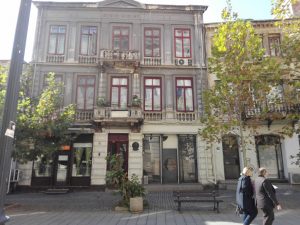
The street sets out from Piaţa Unirii / Union’s Square, borders Piaţa Sfântul Anton / Saint Anthony’s Square along with Strada Șelari / Saddlers Street, goes past Biserica Sfântul Antonie cel Mare / Saint Anthony the Great Church, leaves behind the ruins of Cetatea Domnească / The Princely Fortress (now in full renovation process) and intersects the streets: Șepcari / Cap Makers, Căldărari / Bucket Makers, Şelari / Saddlers. These are street names with mediaeval resonances, according to the name of the handicraft or merchandising practiced on each one of them.
Further on, French Street winds up gently toward Calea Victoriei / Victory’s Avenue, leaving behind Tonitza Street and Strada Poştei / Post-Office’s Street, as a red thread of history. The buildings in this area are among the oldest ones in Bucharest, many of them dating back to around 1850 toward 1920.
The experts claim that today you can hardly find in the capital of Romania edifices built prior to 1847. And this is happening because during that black year in the history of these lands, a fire of large proportions scorched the townsfolks’ settlement who had built for themselves predominantly wooden shops and homes, around the houses of noblemen holding high positions at the Court.
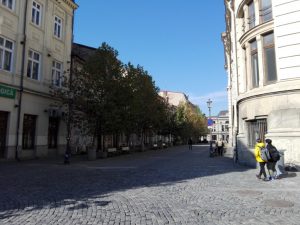
Strolling at a slow pace as you come from Calea Victoriei / Victory’s Avenue, you will discover that French Street has an old-fashioned elegance you can’t help but noticing. Warded by a string of maple trees providing a pleasant shade during the summer and a fabulous color palette during the fall, French Street is a place possessed of a never-ending hustle and bustle, is a place where you can’t help but notice the large number of foreigners come to discover Bucharest.
In spite of this fuss caused by the large number of tourists, French Street has a tranquil air, which seems to convey to you a sort of inner peace helping you to find your inner balance.
In order to relax, you can stop by any of the terraces cladding the place in an air of modernity, not at all disturbing. Meanwhile, you can opt to stroll from one end of the street to the other and discover houses over which history passed.
If you focus on the even-numbered side, you will discover a string of historical monument edifices. The buildings are arranged along a line forcing you to follow the constructions’ details. Hence, at No. 4, you will notice a house that dates back to 1885. A little further down the road, at No. 12, you will discover a construction inspired by the Renaissance, erected in 1850. And the edifice at No. 16 falls into the same category.
The house at No. 14 bears the effigy of Iulia Hașdeu. Sources claim that here dwelt, for a while, Bogdan Petriceicu Hașdeu (one of the most important personalities of the Romanian culture of all times) and his wife. Furthermore, it seems that in this house was born their only daughter – Iulia Hașdeu.
We will turn our attention to the odd-numbered houses as well. At No. 11, edified in 1892, there is M. Russu House. On the pediment, the inscription can be seen even today. The building amazes by its symmetry, by its narrowness, but also by its unique balcony possessed of classical decorations. A similar construction can be seen across the road, at No. 20, this being actually a feature of many edifices on French Street.
On the odd-numbered side of the street, the edifice at number 9 cannot escape notice. It is also a historical monument building, completely changed during 1920, when it acquired an eclectic style and when it was turned into a tenement house.
A Tenement House is an edifice at Romanian Army’s disposal, housing the Army Officers. During that period, the Romanian Army Officers were coerced to marry well-to-do landowners’ daughters. Due to these marriages, a great part of the officers’ time was spent on the estates of their fathers-in-law, and, when summoned at the garrison, they received accommodation in these tenement houses. This way, they had the possibility to present themselves in the barrack when they needed to report.
The tenement house in this area stretches on three parcels, two of them on French Street, at Nos. 19 and 21. These parcels used to be owned by Doctor Gheorghe M. Darvari (1839-1903) and his wife. The other parcel is positioned somewhere behind the two, and exits toward a section of the current Tonitza Street, which in the past was named Sfântul Dumitru / Saint Demetrius, according to the church located here. Originally, the building, reared up according to Architect I. Friederich’s sketches in 1891, was according to the academic style of neoclassical persuasion. “The tourist discovering French Street has the opportunity to see other important monuments in the area as well. For instance, Biserica Sfântul Dumitru / Saint Demetrius Church, also known as of the Oath, located on 20th Tonitza Street. The first abode on this site dates back to the 16th century. The nowadays Church was rebuilt by Constantin Filitti, Bishop of Buzău, being completed during 1843 by his descendants,” specifies Aurel Ionescu.
“It was also called the Church of the Oath, since in it the solemn oaths were taken, when the culprit or the plaintiff […] took the oath next to the altar’s door to the effect that they will speak the truth, the whole truth and nothing but the truth […],” G. I. Ionnescu-Gion tells us in „The History of Bucuresci.”
„Furthermore, on Şepcari Street / Cap Makers Street, at No. 22 B, reigns Biserica Domnească, Curtea Veche / The Princely Church, The Old Court, so-called Sfântul Anton / Saint Anthony. The current worship place was erected upon the ruins of an older Church and founded under the patronage of the Annunciation by Mircea Ciobanul (1545-1552; 1553-1554; 1558-1559). It was Biserica Palatului Domnesc / Church of the Princely Palace, later also called Curtea Veche / The Old Court. After 1847, it picked up also the patronage of Biserica Sfântul Anton / Saint Anthony Church nearby. Not to be missed either is the site on which Biserica Sfântul Anton (Antonie) / Saint Anthony Church – also known “a Puşcăriei” / of the Jail – was formerly located. Built during the 16th century near the building housing Puşcăria Domnească / The Princely Jail, burnt down a number of times, eventually being destroyed by the Great Fire on the March 23rd 1847. It has never been reconstructed. On the place where it was located, a stone monument was erected, and the delineation of the walls is marked on the ground by a hedge,” details Aurel Ionescu.


