
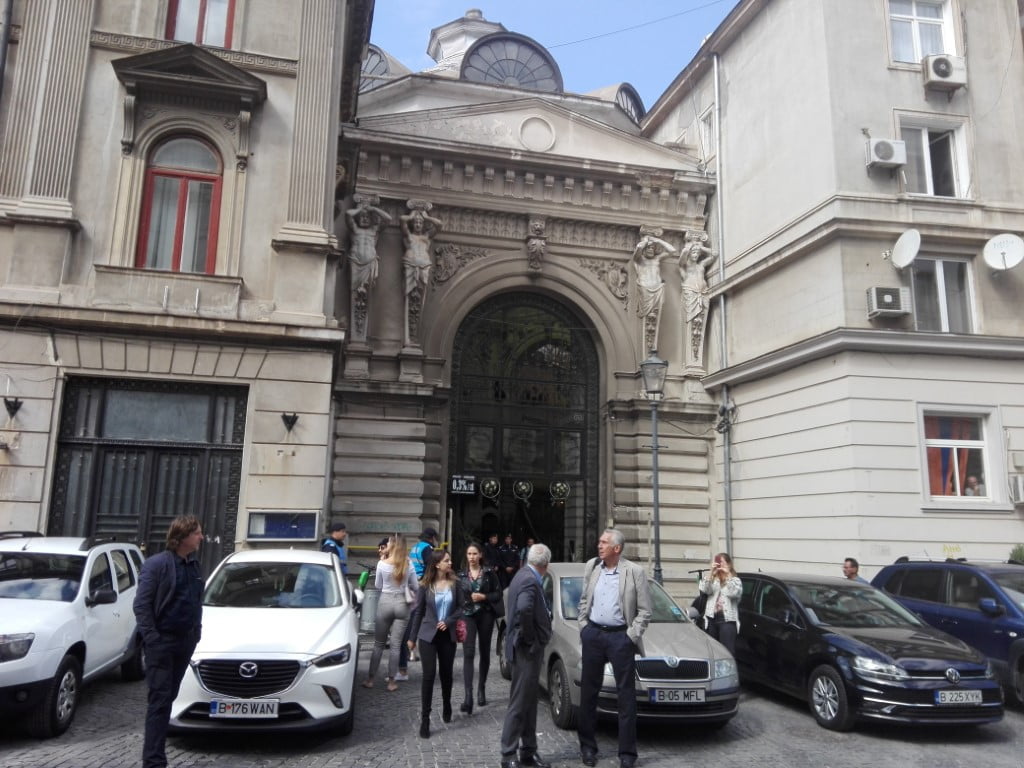
 From the height of the buildings whom they ennoble, “the virgins in Karyae” watch the people passing in a hurry on the capital’s streets. Draped according to the ancient fashion, or exposed to the eye of the bystander in a semi-nudity not at all vulgar, the Caryatids turned, for more than half century now, into the silent watchwomen of Bucharest.
Sometimes by themselves, at other times accompanied by Atlantes, the Caryatids, tell tales about the styles that dominated the architecture of the city beginning with 19th century. The Caryatids are iconic for what meant turning Bucharest into a Little Paris.
“On the Hunt” for Caryatids and Atlantes
And since we wish to discover Bucharest for what it really is, we set out on a peaceful fall day, “on a hunt” for Caryatids and Atlantes.
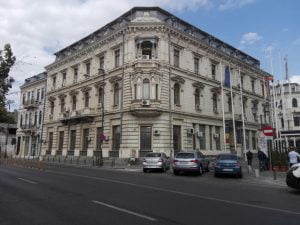
The spot we began our journey from was Splaiul Unirii / Union Embankment. And there was no need to walk for too long, since at No. 2 we discovered a gorgeousness of a house, about which we learned subsequently that was erected around 1890. The edifice has the corners of the first story decorated with windows guarded by Caryatids. The first impact was strong and caused me to clearly see the beauty of these feminine figures which, by the way they are included in the architectural frame of the building, offer the impression that they uphold the whole construction.
Delighted by the first discovery, I set out on foot on Calea Victoriei / Victory’s Avenue. As I got on the French Street, a balcony at the first story of an edifice caught my attention. Two voluptuous Caryatids look sassily at the passersby who are on their way through the area. Though silent, they seem to want to tell the ones willing to listen to them tales about the old Bucharest.
I got back to Calea Victoriei / Victory’s Avenue, I set out on Lipscani and I got to Eugeniu Carada Street. Right in front of the Palace of the National Bank of Romania, the entrance into the covered passageway Macca-Villacrosse is guarded, on either side, by two pairs: Atlantes and Caryatids. The architecture in neo-rococo style is distinctive to the year 1890, when this passageway was built.
We continue our itinerary on Calea Victoriei / Victory’s Avenue and our next stopover is at No. 107, where Ştirbei Palace is located. The construction erected in the middle of the 19th century, more precisely around the year 1835, bears the signature of the French Architect Michel Sanjouand. The edifice combines the neoclassic style with numerous Greek elements, having on the higher façade four terracotta Caryatids.
There is no way to exclude from our itinerary “The House with Caryatids” that we find on Calea Victoriei / Victory’s Avenue at No. 202. Moreover, we must make a stopover on 30th Lascar Catargiu Street, where there is an edifice built also in 1890 and which is decorated with Caryatids.
Further down the road, toward Parcul Grădina Icoanei / The Icon’s Garden Park, on 70th-72nd Dionisie Lupu’s Street, we will meet a historical house. The edifice, dated 1884, was built according to the plans of Architect Ioan I. Rosnovanu.
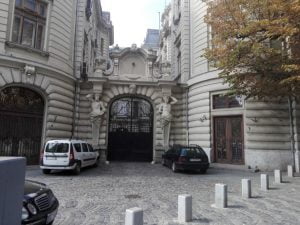
Right across the road from the building of the University of Bucharest, as you head toward Biserica Sf. Nicolae-Ghica Paraclis Universitar / Saint Nicholas-Ghica University Chapel Church, at one of the gates of the historical monument building belonging to A Class in the center of Bucharest, there are two Atlantes standing guard. The building, which housed for a long period of time the headquarters of one of the largest Banks in Romania, was finalized in 1906, according to the designs of Architect Oscar Maugsch and occupies the old garden of the Sutu’s Palace (the present-day Museum of the City of Bucharest).
Other similar statues can be admired on Carol I Boulevard as well, at Nos. 2-4, at the headquarters of the Ministry of Agriculture.
These are only a couple of the spots in which the tourist desirous to discover Bucharest can meet the beautiful Caryatids or the spectacular Atlantes.
The Caryatids Enrich Little Paris
The half of the 19th century brings significant changes to Bucharest, the city coming strongly under the influence of the French architects. It’s the moment in which the fashionable buildings in Paris find their place in the “mioritical” space. The eclectic architecture dominates this period in which the Caryatids and the Atlantes become almost a constancy in the indigenous landscape. The monumental buildings erected in the southern part of the country are guarded either by Caryatids or by Atlantes. There are situations in which the direction is the forming of pairs.
The term Caryatid comes from the Greek Caryatides, meaning “Virgins of Karyae.” In architecture, the Caryatids are feminine figures which replace the pilasters or columns and serve as support for the horizontal rafters. The feminine figures are portrayed either seminude or draped according to the ancient fashion.
The term Atlant is not very clarified, the only certainty being that it presents itself in the form of masculine bodies, either nude or seminude, men that seem to uphold on their shoulders the whole construction they guard.
Both the Caryatids and the Atlantes are a Roman takeover from the Greeks. The European architecture brought in these elements ever since the neoclassic period. In Bucharest, these two elements are among the defining ones for what meant the building process of Little Paris.


