
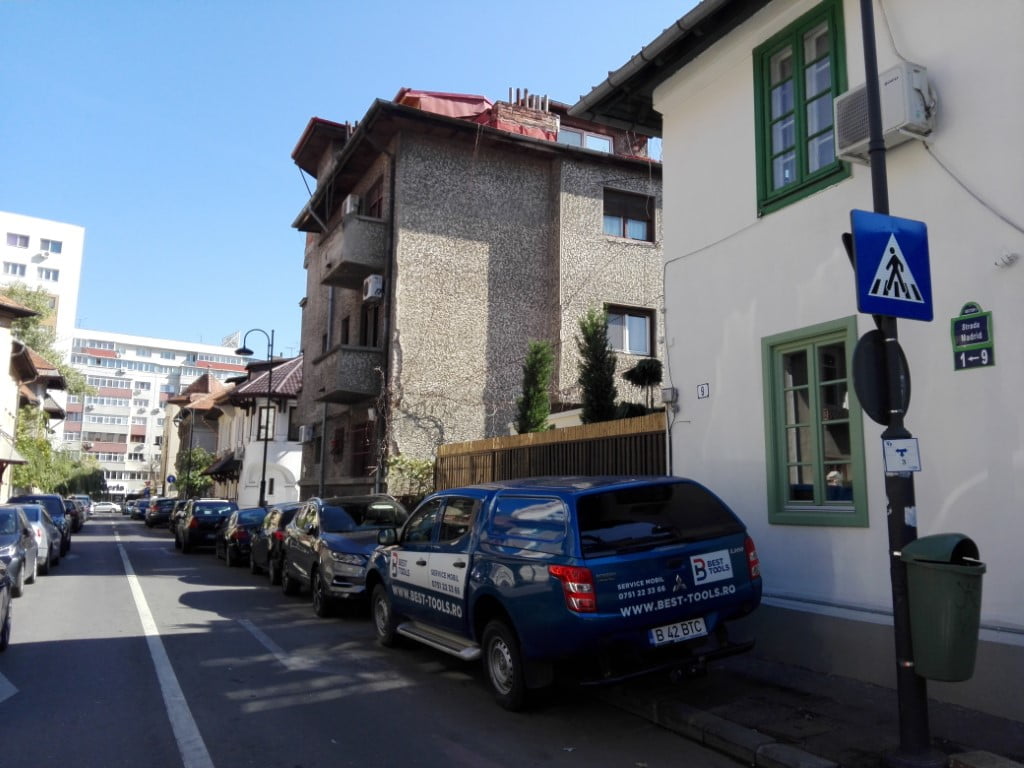
 Our journey through the world’s capitals still continues today, as we stop in Madrid, but in Stockholm as well. Passing from one to the other may seem abrupt, only that the two streets bearing names of capitals in the heart of Bucharest are so close to each other, that you cannot miss the chance to visit both of them during the same day.
We will get on Madrid Street as soon as we leave Brasil Street behind, with its sand-colored mansions and with fig trees at their gates.
The Latin resonance of the name may cause you think you will step into a luxurious, exotic corner. Madrid Street is neither possessed of as much vegetation as one would expect, nor is it possessed of exotic buildings carrying you in your imagination to other corners of the world. Instead, it is possessed of stalwart houses, among which prevailing are the buildings with a ground floor and one story (potentially featuring an attic), that seem much taller compared to the edifices on other streets in the area.
The Street Watched Over by the Apartment Buildings on Dorobați
The street starts out on Dorobanți Boulevard, its apartment buildings drawing a limit line, maybe a little brutish, between the warm atmosphere of the mid-20th century and the promise of the unstoppable fuss that marked out the end of this century and the beginning of 21st century.
Prof. Nicolae Lascu at “Ion Mincu” Architecture and Urban Planning University, tells us that the area where the streets bear names of capitals is the result of the coherent joining, from an urbanistic standpoint, of a number of land divisions, larger or smaller in expanse (with more or less fields / building lots). „The first one was authorized by the City Hall during 1912, the last one during 1935. The buildings’ “styles” – for the most part residences – subscribed to the dominant architectural movements of the period, keeping in mind, of course, the moment in which they were designed and made, but also the landlord’s tastes or preferences,” points out the expert.
Depending on the period during which the constructions were made, we can establish, broadly speaking, the area’s styles.
„The eclectic architecture present in this area of Bucharest is one under French influences, by the acquisition, interpretation and adaptation of a number of residence patterns in the France of those times, while the neo-Romanian architecture sought its sources in the old cultured architecture and in the one in the rural area, adapted to buildings of a modern, urban character. Up until World War I, most of the buildings are possessed of an eclectic and neo-Romanian distinctiveness. After 1920, the eclectic architecture almost disappears, neo-Romanian architecture is still present, up until toward the mid-1930’s, but for the most part, the buildings during the period between the World Wars subscribe to the Art deco architecture and the modern one. Finally, in the second half of the 1930’s, on these streets also, buildings appear, possessed of an architecture of Mediterranean distinctiveness (with venetian hues, for instance),” explains Professor Lascu.
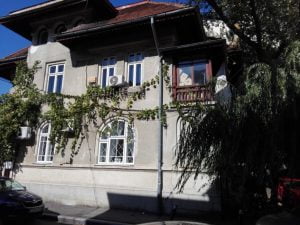
Madrid Street almost submits itself to the mansion at No. 4. The building is constructed in a neo-Romanian style, being stalwart as a fortress. Possessed of a balcony with wooden details inspired by the porches of the countryside houses and the tower characteristic to those residences, the mansion contrasts almost violently to the apartment building that seemingly protects it from the agitated world on the Boulevard.
And since the warm silence of this mansion residential area almost turns us into captives who cannot detach themselves from this place in Bucharest, we can move on the Stockholm Street as well, a bracket of Madrid Street. But concerning Stockholm we are going to speak next time.
A Museum of Architectural Styles
For the architecture enthusiasts, but also for the tourist who wants to discover the joy of visiting the historical part of Bucharest, the area dominated by the streets bearing names of capitals represents a real open-air museum, in which one can enter from any city of the world.
Architect Dan Baciu says that, in the architectural landscape in Romania, this area is one altogether special. „It is one of the best structured areas from an urbanistic and architectural standpoint, distinctive of the period between the World Wars. The style wealth has as its motive the fact that the urbanistic regulations did not impose stylistic solutions. They don’t do it now either, except for the protected areas. Nevertheless, I do believe that for the sake of the preservation in good conditions of these architectural gems, urbanistic regulations as complete and as coherent as possible must be devised for protected areas; as detailed as down to the postal address. The involvement of the Ministry of Culture, through the competent committee, and of HNI (editorial note: Heritage National Institute), by drawing up sheets with usage obligations for historical monument buildings, is another measure that is necessary,” the Architect mentions.


 – Madrid Street)