

 After walking along the elegant Tokyo Street, we move towards another mysterious place: Ankara Street. We start from Calea Doronbanți, an artery that connects Charles de Gaulle Square with Lahovari Square, near the Roman Square.
Calea Dorobanți, one of the most important boulevards of the Capital, has a special historical significance, in the context in which it retains its name from 1878. The name of Dorobanți reminds of a major event in our history, the War for Independence of 1877-1878, moment in which the Romanian soldiers were victorious, and the Romanian Principalities gained independence from the Ottoman Empire.
Since the Belle Epoque period, this area has been an exclusive one, with sumptuous villas, luxury shops and elegant cafes or restaurants. A wide, bright arterial road, which represents the east side of the grid with streets bearing the names of capitals and countries, known as “Filipescu Parceling”.
As we have shown in our previous articles, a walk through this area of Bucharest is not only relaxing, it is also an opportunity to meet the history and architecture of the city.
To the “capital of Turkey”
From the cozy Dorobanți Square, where a small park dedicated to the great sculptor Constantin Brâncuși is arranged, we pass through the streets of Rome and Paris, to enter the following street: Ankara.
The first villa from this perspective, the one at number 7, built in the Neo-Romanian style, looks like a slice of cake placed at the junction of Ankara and Sofia streets. In fact, on the whole side of the street with uneven numbers we find an alternation of neo-Romanian and modern styles, with sober, light-colored facades, which give brightness and a wide feeling of the whole street.
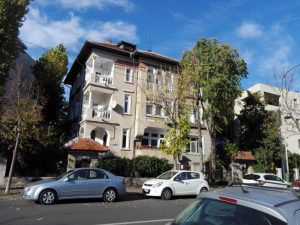
At number 1, the imposing building bears the signature of the architect Gheorghe Șimotta (1891-1979). The villa, with the ground floor raised and two-floors, has an apparent brick belt under the cornice, and the arched polyphorous windows on the top floor have masonry columns with stylized capitals, decorative elements that we find in most of the creations of the well-known architect.
Moreover, as on the neighboring street, Athens, the creation of the architect Gheorghe Șimotta influences the style of the buildings nearby, in the sense that they all seem to gather and reflect the light so that the space seems much wider and more open even on a cloudy day.
Professor for 30 years at the Faculty of Architecture in Bucharest and the author of numerous buildings that have become emblematic for Romania, the architect Șimotta contributed to the development of the city in one of the periods of municipal flowering: the interwar period.
On the side with even numbers, at the end of the street, from Khalil Gibran Park (where Athens and Rabat streets merge), at numbers 2 and 4, there are two special white villas, both registered in the category of historical monuments.
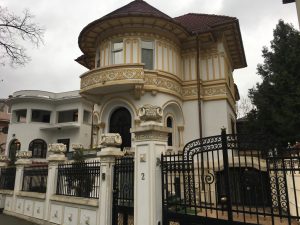
The villa from number 2, with ground floor and first floor, has columns with stylized capitals that frame the entrance door, and the upper level is delimited by the ground floor through a belt with plant motif decorations. The same motif decorates the belt under the cornice.
For the number 4, in 1929, the architect Ernest Doneaud requested a building permit. The request specified the address of a villa “in the extension of Vulpache 20/32 in Filipescu Park”, which corresponds today to the address of the building on Ankara Street number 2.

Ernest Doneaud (1879-1959), despite his name with French resonances, is an important figure of the Romanian architecture. He collaborates with the architects Dimitrie Maimarolu (1859-1926) and Paul Smărăndescu (1881-1945) and realizes the interiors of the Military Circle in Bucharest and the Maternity Building in Iași. Also, he is requested for the execution of the houses of some personalities of the time: doctors, career soldiers, politicians. He has essential contributions in the systematization projects initiated by the authorities of the Capital, participating for example, in the period 1908-1910, in Lânăriei Parceling.
The building on Ankara Street number 4, although it has undergone changes over time, still retains details that fit it in the modernist current, adopting also Art Deco elements: the belt under the cornice, the asymmetrical windows on one of the side walls, the windows arched from the ground floor in opposition to the rectangular ones from the first floor.
The other buildings on the side of the street with even numbers have the same alternation of styles: modernist with Art Deco and neo-Romanian accents, keeping the cadence with the villas on the opposite side.


 - Ankara Street)