
 The student world in Bucharest is in a continuous bustle, and the higher education institutions in the city have managed to attract many young people from abroad who have decided to come to our country to attend a college, a master program or a PhD program. The number of foreign students, but also the way they subsequently promote the country that adopted them during their studies, is a confirmation of the fact that our universities are perfectly integrated into the international landscape.
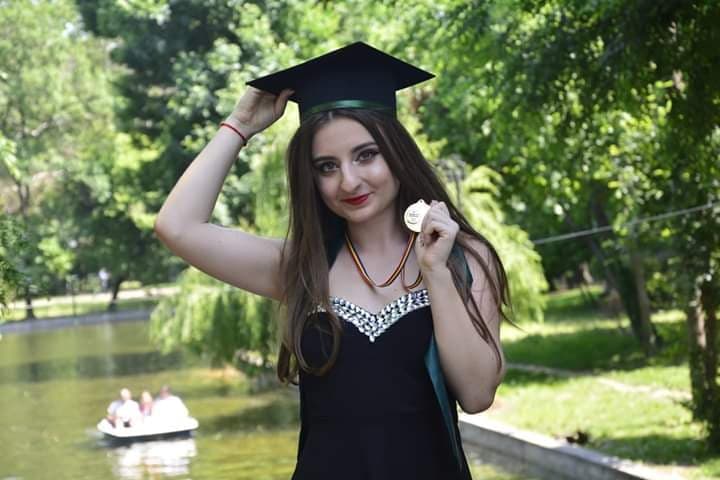
I met Milanka Noveska by chance. She came to Romania for some time, being a student at the National University of Music Bucharest. She is preparing for a career on the great stages of the world, and the results she has achieved so far come to confirm his talent.

She was born in Ohrid, Macedonia, and her passion for music was discovered early. She says that all her life she liked to sing. After completing the high school studies in her hometown, Milanka opted for the music school in Skopje.
She came to Bucharest to continue her studies, and the choice of the educational institution in our country was not a coincidence. “The National University of Music Bucharest is highly appreciated internationally. After receiving many recommendations for this school, I decided to come to take the hearing in order to be admitted,” says the young woman.
Music is not her only passion. From a delicate person, who translates into various roles in the works of the great composers, you would not expect to be told that she is taking martial arts courses for several years. Well, Milanka is training hard, relying especially on Shotokan karate training. But let’s go back to music, her great love.
Tradition in the arts
Once in Bucharest, Milanka Noveska discovered a country with a tradition in the cultural field, but especially a country where classical music is highly appreciated. „Bucharest is a center where a young artist can fulfill itself. It is a city in which many projects involving art are carried out. An artist has no way of feeling a stranger in a community that knows how to appreciate his work. I personally have never felt a stranger. Each time I had a fair treatment, which involved only my performance, without any connection to my nationality or to the country where I come from. It is precisely for these reasons that I decided to stay and join the master program,” states the opera singer.
A noisy but grandiose city
When she first stepped into Bucharest, the city seemed very noisy, but at the same time, she was conquered by its grandeur. For Milanka, it is the ideal city for people passionate about authenticity. And the authenticity of the Romanian capital results from the mixture of which is made up. “I really like the environment around me. I like nature in parks. I like the good food I find in different places in the city. I like the freedom I feel here. I like the evolution that I could rely on in Bucharest. And I think that, most of all, I like the relationship with the people I love, people who have become like a family in a foreign country where I was always welcomed with open arms”, emphasizes the young student.
She confesses that she has many places in Bucharest that are very dear to her. One of them is the National University of Music Bucharest, the place where she is preparing for the successful career she wants. She also enjoys the student dormitory of the faculty, because it is a place of diversity, a place where people have crossed any barrier and formed a beautiful community.
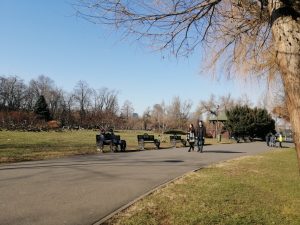
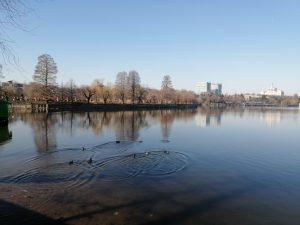
She also has moments when she relax during long walks through Cișmigiu Park or admiring the lake in Herăstrău Park.
But most of all she likes the “stage” in Bucharest. And by “stage” she refers to all the places where she was allowed to present her art, in the places where she sang.
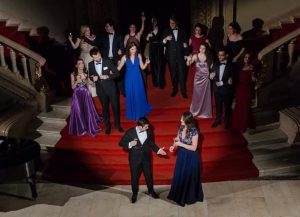
Referring to the places where she had the opportunity to play, Milanka indicated the Bucharest National Opera where she was involved in a project dedicated to young talents. “It was a great experience and also a pleasure for me,” says the soloist.
In addition, she was part of the Radio Academic Choir in various projects, and this allowed her to discover that here the professionalism is at a high level and the atmosphere is extraordinary.
“A place that I love very much is the Comic Opera for Children, an institution that works as a family. That’s how I think any theater should work. I am very grateful that I was part of the projects of Comic Opera for Children. The most recent role that I had was Tisbe, Cinderella’s sister, from the opera La Cenerentola by Gioachino Rossini”, tells the young woman from Macedonia.
I asked her to tell us what should be done in order for Bucharest to have greater visibility abroad, and the answer she gave us is related to the fact that the city should enjoy a wider presentation in the online environment, so that more and more people will find out about the beautiful places in the Romanian capital.
A university with a tradition of 156 years
The discussion I had with Milanka Noveska, but also with other students or artists that I presented in this program, gave me the opportunity to find out more about one of the traditional educational institutions in Capital of Romania: The National University of Music Bucharest.
The university where there is a perfect balance between the old and the new has formed many generations of artists who have delighted and still delight the souls of the spectators from all over the world.
The Bucharest institution came into being in June 1863, when a decree of the Council of Ministers was issued, chaired by the ruler Alexandru Ioan Cuza. A year later, the institution was founded and on October 6th, 1864, it began to operate under the leadership of composer Alexandru Flechtenmacher.
The idea from which it started was that the new institution should include two main art schools, which have branches both in Bucharest and in Iasi. Thus a cultural bridge was formed between the two cities.
The first name that this institution was the Music and Declamation Conservatory and included the “Institute of vocal music” and “School of instrumental music”.
It was the beginning of a tradition, the Conservatory led by the composer Alexandru Flechtenmacher transforming very quickly into a European institution in which both national music personalities and international music personalities were prepared.
The name of Alexandru Flechtenmacher is not only related to the first stage in the history of this institution. The musician is also known for being the author of the first Romanian operetta. It’s about “Baba Hârca”. The text belongs to Matei Millo, the one who played, in the travesty, the main role at the premiere of the show that took place in December 1848, in Iasi. Also, Alexandru Flechtenmacher is the author of the music for “Hora Unirii”, on the lyrics written by Vasile Alecsandri.
The fact that he was entrusted with the management of this institution represents both an appreciation of its value and a highlight of the importance that the Music and Declamation Conservatory had at the time.
Specializing in vocal and instrumental music education, the school consisted of violin, solfege, church choir, singing, piano and harmony classes.
Step by step, the Conservatory has diversified its specializations. In 1900 it included the first class of chamber music, and in 1905 the first composition class, under the direction of the artist Alfonso Castaldi.
Another important moment in its history is the transformation of the institution, on July 17th, 1931, into the Royal Academy of Music and Dramatic Art. This is the time when George Enescu was an honorary professor here, with many students having the chance to enjoy the genius of the musician.
The institution continued to transform and change its name. Thus, it was known, during the communist period, under the name “Ciprian Porumbescu Conservatory”, so that during the period 1990-1998 it will bear the title “Bucharest Music Academy”. After 1998 it becomes the University of Music Bucharest, so that from 2001, it will be established, by a government decision, that the institution will be called the National University of Music Bucharest.


