
 The beauty of today’sBucharest is the result of the efforts of certain personalities less known among the people who explore the city as mere tourists. The architects and engineers who contributed to the development of the Romanian capital city remained in the shadows, their art being visible throughout the city, without knowing the names of those who designed thoseremarkable houses which turned Bucharest into a unique metropolis within the European landscape, or who initiated the systematisation of the city having led to its modernisation.
Grigore Cerchez is one of the personalities who has left us a series of emblematic projects in Bucharest. We shallrefer to him today and to the influence he had on Little Paris.
The debut of “la belle epoque” in Bucharest brought a significant transformation of the city, which underwent important urban and systematisation changes, in tune with the social evolution, changes that have justified the name consecrated to it, that of “Little Paris”.
Thus, in 1873, the year when he graduated from his studies in the “City of Lights”, the engineer and architect Grigore Cerchez (1850-1927) was employed by the Ministry of Public Works, and in 1875 he was appointedChief Engineer of Romania’s capital city.
It is for good reason that we evoke thehigh offices he filled. At that time, the sewerage plans of the “Grădina Icoanei / Icoanei Garden” area were related to Cerchez’s name. He was also involved, between 1880-1883, in the elaboration of thecanal work plans for the Dâmbovița river, but also in the plans for the systematisation of the city, realisedat that time.
He dedicated all his endeavours to Bucharest
For half a century, from the teaching positions held at the Faculty of Architecture or at the Polytechnical School, from the administrative officesfilled or as creator of some reference buildings, Grigore Cerchez left acrucialmark on the evolution of the Romanian architecture.
The first period of his career was deeply influenced by his studies abroad. It was the period when he designedbuildings in the neoclassical, eclectic and neogothic style.
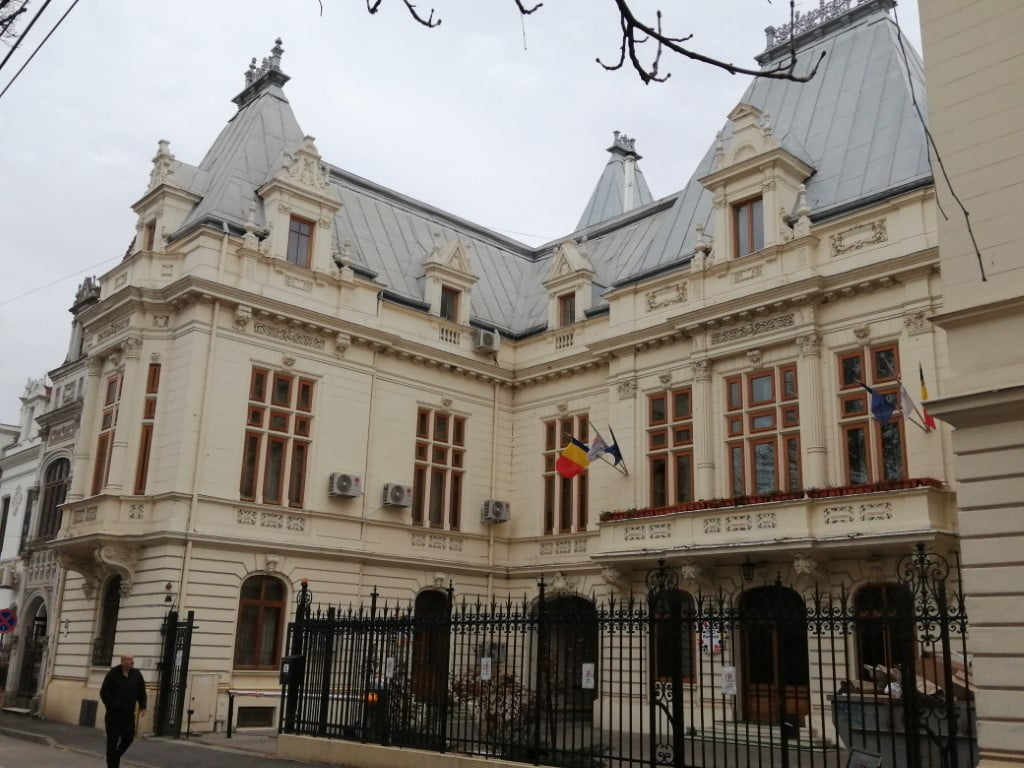
From that time, we can still admire the Sihleanu House (built in 1889 on Simu Atanasie Street, at number 1, behind the Romanian Athenaeum), now turned into a café.
From that period equallywe inherited the house situated on Nicolae IorgaStreet, at number 12, built in 1882. The building was erected at the request of the historian Mihail Șuțu.
In his early years, Grigore Cerchez also worked on the facades of the “Grigore Antipa”National Museum of Natural History.
One of the founding fathers of the Romanian architecture
After 1906, a stylistic diversification occurred in the works of Grigore Cerchez, who started to include emblematic elements of the national stylein his creation.
In the period 1906-1910 he built the house of Emil N. Lahovary, located on Gina Patrichi Street, at number 10, a building in French neo-Gothic style, which has a main body and two lateral wingsdelimiting a court of honour in the style of the French Renaissance. The facade and the roof with attic are richly ornamented, exhibiting geometric and vegetal details. The beneficiary of this “hotel particulier” or private dwelling was the politician Emil Lahovary (1855-1930), and in the first years of the twentieth century it was the headquarters of the American Legation in Bucharest.
Between 1905 and 1912, together with the architect Alex. Clavel, he elaborated the plans and led the works for the modificationof the building situated onCaleaVictoriei / Victory Drive, at number 196, construction located opposite the building of the “George Enescu” Museum.
The work was requested by lawyer Constantin G. Dissescu –a university professor, author of the first Romanian course of constitutional law and Minister of Justice for a short period of time.
The building wasremodelled in the Neo-Romanian style, the façade onCaleaVictoriei/ Victory Drive having a loggia inspired by the Brancoveanu-inspiredarchitecture, with arches supported on columns with twisted grooves and with stone railings carved with floral and zoomorphic ornaments.
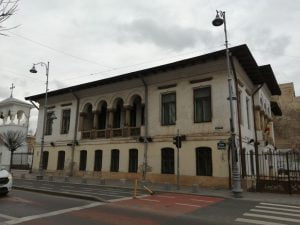
After the death of Constantin G. Dissescu, in 1932, his former house sheltered the Institute of Italian Culture (1933 – 1949), then that the Romanian-Russian Institute, until 1956. Since 1967, it has been the headquarters of the “George Oprescu” Art History within the Romanian Academy.
The interior premises still preserve elements of the design imagined by Grigore Cerchez and house the institute’s heritage: an art library unique in the country, documentary archives, a collection of fine arts from donations made by Professor Oprescu, the engineer Gheorghe Bals and the Busuioceanu family.
In this context, we should mention that, although legally constituted in 1948, the Institute of Art History was established and began to function the following year under the leadership of Professor George Oprescu. Professor Oprescu held the position of director of the institution for 20 years. During this period, the foundations of fundamental scientific research in the field of art history were laid and synthesis works on the history of Romanian art were elaborated. It was organised by departments with different profiles, and George Oprescu initiated the multidisciplinary approach in the study of medieval art, Byzantine art, the history of theatre, cinema, music and architecture. Between 1950 and 1960, they founded thelibrary and journalsof the institute.
Grace to the contribution of Grigore Cerchez, as well as to the work of Professor Oprescu, theBucharest of our epoch benefits from an art institute housed in a heritage building.
A replica of the French castles
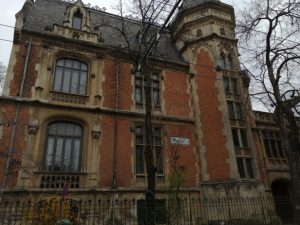
Another impressive house, signed by the architect Cerchez, is located near the Dissescu House, on Gheorghe Manu Street, at number 9. It is the Niculescu-Dorobanțu House. The building was commissioned by one of the daughters of the Liberal Party politician Ion C. Brătianu, Tatiana Niculescu-Dorobanțu. At her express request, Grigore Cerchez conceived and built, in 1911, a historical replica of the French castles of Renaissance inspiration, with neo-Gothic decorations.
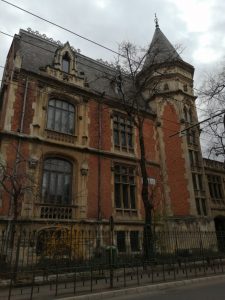
In correspondence with her sisters, Tatiana was very proud of her home „in Louis XII style, with carved stone and apparent brick (…) I found that, without possible comparison with them (n.r. the French castles on the Loire Valley), my house is very beautiful. Unfortunately, because of the narrow street, the palace seems somehow crammed”.
The building resembles a Gothic cathedral. It is noticeable due to the distinctive elements, such as the apparent brick masonry, in various shades of red, the silhouettes of the towers, the entrance portal, the imposing windows with mullions carved in stone, in French neo-Gothic style, the fretwork details of the terraces and windows, the cornices, the gargoyles, the stained glass windows and the broken arches. All these details mark both the exterior and the interior.
He left his mark on CaleaVictoriei
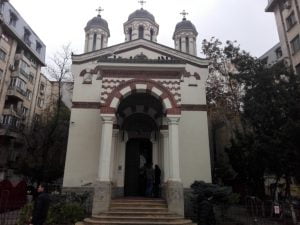
The restoration of the Zlătari Church carried out between 1907 and 1908is also linked to the name of Gregory Cerchez.
In fact, the architect was involved in a very comprehensive project, which aimed at widening the space occupied by CaleaVictoriei/ Victory Drive. The works were designed so as not to compromise the constructions in the area.
Furthermore, also as part of the modernisation of this essential routethrough the Romania’s capital city, one conceived, between 1910-1911, on the former property of the Lahovary family, the ensemble formed by the present Odeon Theatre and the former Majestic Hotel.
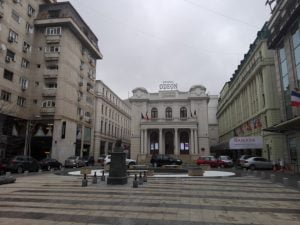
Historical sources mention that the architect Grigore Cerchez designed a vast ensemble. The project was initiated by Emil Lahovary. The information available on the Odeon Theatre website shows that this project led to the construction of the Theatre of Comedy, located to the side of the Academiei Street, but with the facade oriented towardCaleaVictoriei/ Victory Drive, flanked by two side wings, with shops and apartments to the north and Hotel Majesticto the south. The theatre was inaugurated on December 25th1911, followed by the autonomous side wings – Hotel Majestic and the northernwing with apartments and shops, configuring thus the two passages. (…) The theatre underwent some transformations towards the middle of the 20th century, the enlargement of the hall, the elevation the stage and the introduction of connecting bodiesto the side wings – annexes of the stage – over the two passages. The 1945 bombings affected both the theatre and the side wings, especially the northern one, which was partially restored”.
The legacy of Grigore Cerchez also includes the Bucharest School of Architecture. Here, the work began in 1912 and was completed in 1927.
During this time, the architect also realised the facades of the Academy of Economic Sciences (Academy of High Commercial and Industrial Studies of Bucharest) whose design was realized by the architect Edmond van Saanen-Algi, and the contractor was Gr. G. Cerchez).
Moreover, starting with 1912, he was in charge with the interior design and extension of the north side of the Cotroceni Palace. For this wing he usedthe national romantic conception, adding a large hall with a terrace above and two pavillions with columns. One of these pavilionswas a replica of the famous pavilionfrom the Hurezi Monastery, situated in Valcea county.
The activity of the architect Grigore Cerchez is synonymous with the modernisation of Bucharest, the legacy left to us by this great personality having a value still difficult to quantify.


