
 The communist epoch has made its mark on the architecture of Bucharest, transforming many areas of the city. We decided to follow in the footsteps of the builders of that period, to discover symbols that have remained a legacy from the years when the power was held by the “single partyˮ.
The tourist who wants to know Bucharest as it really is will have to find out that part of history that many try to erase with a sponge in order to make any trace related to communism disappear. For more than half a century, Romania has been under the dictatorship of such ideology, and the effects are still felt today in all the aspects of the everyday life.
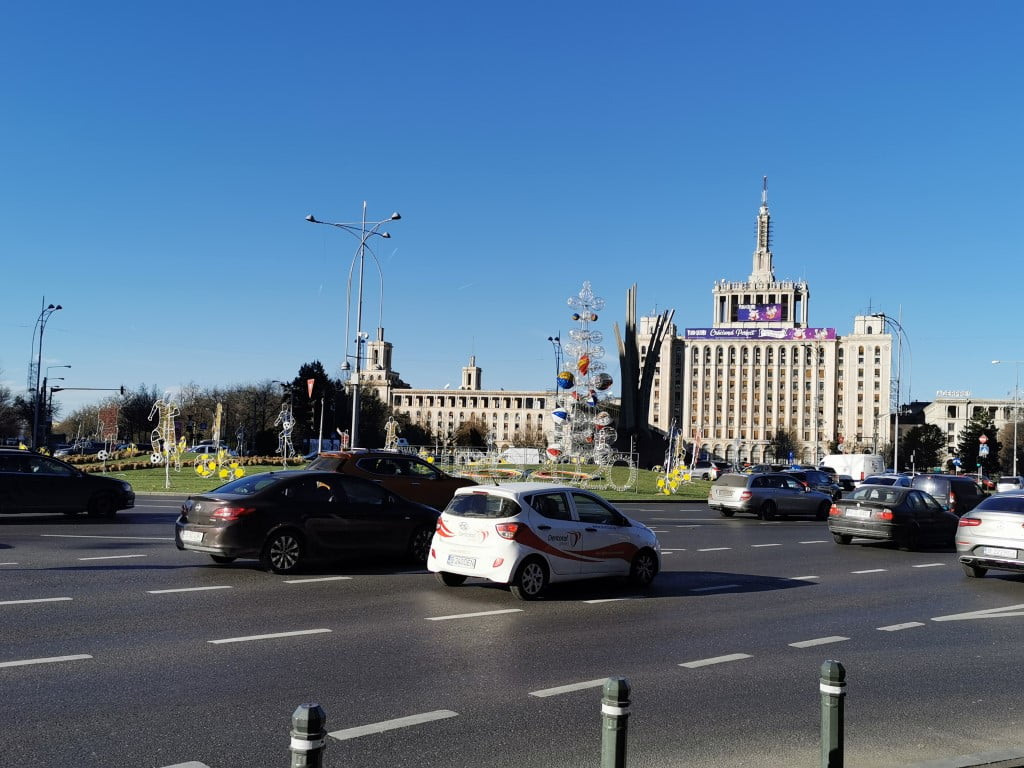
Casa Scînteii, at present The House of the Free Press
Casa Scînteii (House of the Spark) was one of the first constructions that the communists built; today it is known as the “The House of the Free Pressˮ.
The impressive building, located very close to one of the large entrances to the city, was erected on an important piece of a construction known in the interwar period, namely, Băneasa Hippodrome stadium, a place that the communist leaders believed to promote bourgeois customs.
The Hippodrome was inaugurated in 1908, being built according to the plans of the architect Ion D. Berindey. Immediately after it was inaugurated, it managed to attract the “cream of the high society” in Bucharest, and during the inter-war period it was a place where a series of national and international racing events were organized.
Once in power, the communists decided that Băneasa Hippodrome should disappear from Bucharest landscape, so they started to demolish it.
Casa Scînteii Complex started to be erected in 1952, on a part of that plot of land. The team of architects who implemented this project included Horia Maicu (known before his name was “romanianisedˮ as Harry Goldstein), who, between 1958 and 1969, was the chief architect of Bucharest. Likewise, the group of engineers involved in the design of the building was led by Panaite C. Mazilu.
In Bucharest, The House of the Free Press is a grandiose building that can be at any time an outstanding tourist destination.
Even if the specialists who made it were mainly inspired by some buildings in Russia (an example is the State University of Moscow), the construction also includes many decorative elements of Romanian inspiration.
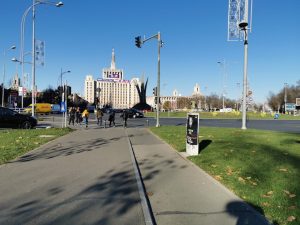
The building, which was inaugurated in 1957 and was designed to withstand strong earthquakes, housed much of the communist propaganda press, with “Scînteiaˮ (The Spark) newspaper at its peak.
Another symbol of the communist architecture was erected on another part of the surface of land left free after the demolition of Băneasa Hippodrome,: “The Pavilion of the Exhibition of the Achievements of the National Economyˮ, turned into, after 1989, ROMEXPO Dome.
The State Circus
The early years of communist era left us another architectural legacy of Bucharest. The State Circus was built between 1960 and 1961. Today, the Metropolitan Circus operates here.
Nicolae Porumbescu, Constantin Rulea and Nicolae Pruncu were among the architects who were involved in this project.
The ensemble consisting of a theater and several annexes was built in one of the working-class districts of Bucharest. Through this project, the socialist regime intended to contribute to the acculturation of the masses and to the development of recreational spaces.
The State Circus has been included in the category of historical monuments and, like other buildings erected during the Communist era, can be part of any tourist circuit at any time.
The hall for the circus performances, which today hosts the events of the Metropolitan Circus, is impressive due to its form. It has an amphitheater covered with a reinforced concrete dome. This dome looks like a corrugated canvas, reminding of the theater curtain. The way in which the performance hall was designed causes the entire public attention to be directed to the circular arena where the events take place.
The Palace Hall
Another symbol of the communist architecture is the Palace Hall, a place where national and international celebrities have concerts nowadays, but also a place which hosts a series of large conferences.
The Palace Hall was inaugurated in 1960 and was built to match the nearby building that houses the National Museum of Art of Romania (The Royal Palace). The architecture of the Palace Hall bears the signature of a team of architects including Horia Maicu, Ignace Serban and Tiberiu Ricci.
Historical sources indicate that the Palace Hall was erected on the ruins of the building in which Marshal Ion Antonescu was arrested during the events of the 23rd of August 1944. The old building was called “Casa Nouă” (The New House) and was destroyed by the German bombings that hit the capital of Romania on the 24th of August 1944.
The one who ordered the erection of the Palace Hall was Gheorghe Gheorghiu-Dej himself. Moreover, the building was inaugurated with a grand event of the regime: the 3rd Congress of the communist party led by Gheorghiu-Dej.
Nicolae Ceaușescu was also among those who contributed to the erection of the Palace Hall. In 1982, the communist dictator ordered the increase of the capacity of places in this space. This is how the Palace Hall has at present a total capacity of 4,060 seats.
The history of Romanian television building is also closely linked to that period. If we talk about symbols of the communist architecture, we should mention that the current headquarters of the TVR (Romanian Television), in Calea Dorobanților, was inaugurated in 1968.
Cranes laughing in the sun
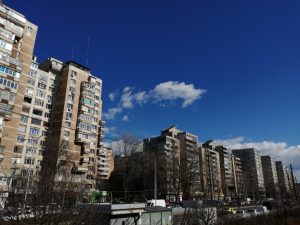
Another symbol of those times were the so called bedroom districts. Even though today’s working-class neighborhoods have changed visibly due to interventions aimed at changing the landscape (green spaces, parks, rehabilitation etc.), they remain a construction of the communists who wanted to obtain uniform masses.
The history of communist architecture is not complete without mentioning Bucharest subway. Although it is difficult for many people to recognize, the subway is an achievement of those times and Bucharest is fully enjoying it today.
Born from Ceaușescu’s desire to bring Bucharest among the metropolitan areas of the world with underground transport, the subway was inaugurated on the 19th of December 1979, when the first section of the first Line was used, running from Semănătoarea Factory to Timpuri Noi District. The construction work began in September 1975 and by 1979 there were 8.1 kilometers of underground network completed.
After the grandiose inauguration, the works continued, with more sections and lines becoming operational at regular intervals of time.
Bucharest subway is still expanding at present, new routes are expected to help free the surface traffic in the city.
The present image of the Dâmbovița River throughout the Capital is also a consequence of a project started during the communist regime of which only 70% was fulfilled.
In the 1980s, a group of engineers developed a plan to establish a navigable link between the capital of Romania and the Danube. The project known as the Danube-Bucharest Canal includes works of the Dâmbovița River too.
The People’s House
We cannot conclude this tour of Bucharest without a reference to the famous “People’s House”, known today as the Palace of Parliament. For many reasons, this remains the most impressive construction made during the communist period.
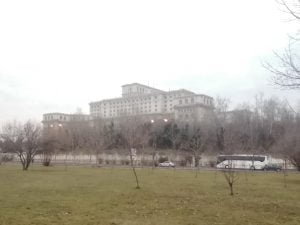
The 1977 earthquake, which brought down many of the historical buildings in the Capital, gave Nicolae Ceausescu the opportunity to implement his “Bucharest Projectˮ. Immediately after 1980, extensive demolitions began in the center of Bucharest, meant to make room for the amazing construction envisaged by Ceausescu.
More than 40,000 people were evicted from their homes and had to move to other homes, while demolitions expanded over several square kilometers. Important buildings in the Romanian capital fell down victims of this project. Among them Brâncovenesc Hospital, the National Arenas and Văcărești Monastery were the most outstanding.
The building known today as the Palace of the Parliament was erected under the coordination of the architect Anca Petrescu. The teams of workers involved in this project worked in three shifts for seven years. The human resources and the materials used were impressive. The final product is not less impressive, the Palace of the Parliament being the second biggest “administrative building” in the world, after the Pentagon.


