We invite you to walk together in the universe of Zambaccian, the art collector who loved beauty so much that he left us a museum with a unique value.
We are in the middle of winter, but the outside temperatures are not too low, so we started walking from the Aviatorilor subway station to the Zambaccian Museum. I took the opportunity to discover another corner of Bucharest where tourists passionate about architecture with inter-war perfume have the opportunity to see real jewelry. We started on the street “Zambaccian Museum”.
The building was specially built to house the Zambaccian collection.
The row of houses, which cover both sides of the alley, forms a true open-air museum. Whether we choose to walk in winter, spring, summer or autumn through this area of Bucharest, we can enjoy, every season, the beauty of the villas built in different architectural styles.
Our target was the Zambaccian Museum, so on a mild winter day, just after 10:00 a.m., we passed the threshold of this place where we were given the chance to meet some of the greatest artists.
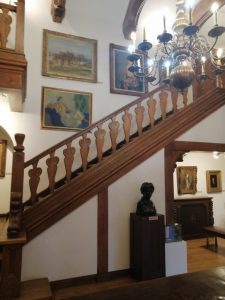
The spectacular interior of the Zambaccian Museum.
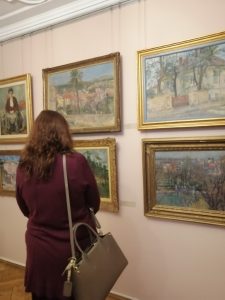
The museum building has a superb interior, in which the precious wood blends perfectly with the uniqueness of the exhibits, giving birth to a universe that only Zambaccian could create. On the ground floor you can see Ștefan Luchian, Camil Ressu or Oscar Han. The stairs and the floor are perfect hosts for other precious artists, such as Nicolae Tonitza, Theodor Pallady, Nicolae Grigorescu and Gheorghe Petrașcu. I gave only a few names, because in this museum are displayed impressive works signed by other masters: Cézanne, Picasso, Matisse, Bonnard, Utrillo, Marquet. They are unique works in Romania.
And because, every time we visited a museum, we presented some of the exhibits that impressed us, and in the case of Zambaccian we will do the same.
You have the opportunity to admire works by Cézanne, Picasso, Matisse, Bonnard, Utrillo, Marquet.
Our presentation, structured with the help of experts from the Zambaccian Museum, does not claim to be a top, but it is just an exposition of some of the works you can admire.
Andreescu, an excellent landscape painter
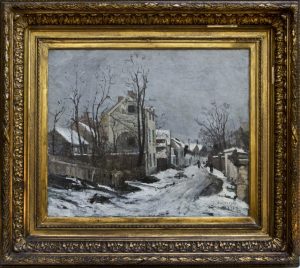
We will start the presentation with one of the paintings of Ion Andreescu, the Romanian artist whose destiny was suddenly broken, at the age of 32, because of tuberculosis.
Ion Andreescu, “Winter”.
At the Zambaccian Museum you have the opportunity to admire the work “Winter”. The painting highlights the artist’s personality very well. Andreescu is one of the important names of the Romanian painting from the end of the 19th century. “A landscape designer par excellence, Andreescu arrives at Barbizon, where he paints en plein air with French painters, but also with his compatriot, Nicolae Grigorescu. The latter immortalizes the meeting between the two through the portrait he makes to his young colleague who went to work in the forest on the outskirts of Paris. Andreescu excelled as a landscape painter, training largely as a self-taught artist. Of the landscapes in the Zambaccian collection, the one with the hybrid subject has a special significance. Purchased in 1927, the collector tells in his memories that he paid for this work the amount of 100,000 lei, the equivalent of an apartment at that time,” explains our host.
Dărăscu, the painter who feels the attraction and spell of the sea
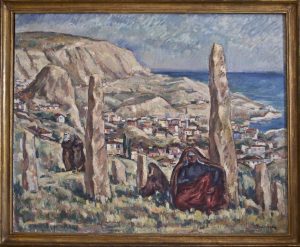
“Tatar Graveyard in Balchik“, a work signed by Nicolae Dărăscu, is the second exhibit we bring to your attention.
Zambaccian loved all the artists we see today displayed in the museum that bears his name. About Dărăscu he said he feels the attraction and spell of the sea, not only as an artist, but also as a navigator.
Nicolae Dărăscu, “Tartar Cemetery in Balchik”.
The painting I chose depicts the story of the little paradise on the seashore, Balchik, one of the great chapters of interwar art.
Balchik, also known as the “Silver Coast”, due to the limestone shore that strongly reflects the light, is a place that many painters loved and presented in their works. The Romanian artists were attracted by the exoticism of this place.
“The little corner of the East, suggested by the minaret, which was just sketched and by the imposing oriental presence of the characters in the foreground, was a real magnet for the interwar artists. They particularly appreciated the physiognomy specific to the Tatars, but also the vestments that offered a special monumentality to those who wore them,” emphasizes our guide, referring to the painting made by Nicolae Dărăscu.
Work from the impressionist period of the painter Nicolae Grigorescu
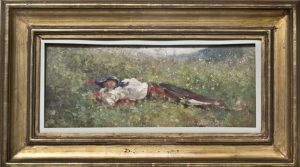
Nicolae Grigorescu, “Peasant woman lying on the grass”
Nicolae Grigorescu does not have to miss this presentation. The painting “Peasant woman lying on the grass” presents the central character in a moment of reverie in the grass only suggested by the artist by color. “The expressive, short line, color that directly forms the volumes without giving importance to the construction places this painting in the period of impressionistic creation. Grigorescu captures the passing moment by a quick sketch of the character that blends into the landscape just suggested”.
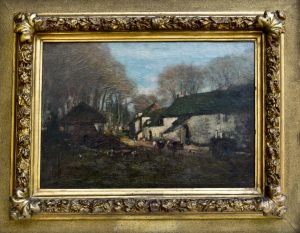
Nicolae Grigorescu, “Farm at Barbizon”.
Another representative work for Grigorescu is “Farm at Barbizon”, an oil on canvas glued to the wood. While admiring the painting, one of the museum’s specialists tells us that, in 1862, during the Parisian studies, Grigorescu participated in the famous “tree contest”. The theme of this contest was a historical scene in a landscape. “In order to document himself, the painter studies the secular trees near Paris, in the Fontainebleau forest. From this moment the entire decade is dedicated to the study of nature, and from this moment Barbizon transforms, for the young Romanian artist, from a simple village into a true colony of painters. In the Zambaccian collection, the work “Farm at Barbizon” evokes precisely the atmosphere of this village in which Grigorescu knows the deepest change in the style of painting, abandoning the painting of academic type learned in Paris to finally arrive at the impressionist approach. This landscape is precisely the moment of passage in the artist’s career. The visitor can also admire in the Zambaccian collection another work from the same period, “Guardian of Chailly”.
“Lăutul”, the monumental creation of Stefan Luchian
Stefan Luchian, “Lăutul”.
The museum also houses one of the last monumental works from the creation of the painter Ștefan Luchian. It’s about “Lăutul”, an oil on canvas. The painting arrived in the Zambaccian collection after the death of another great art lover: Alexandru Bogdan-Pitești. “Although the subject belongs to the daily life, being essentially a genre scene, “Lăutul” was admired for its decorative appearance by the French painter Marquet, noting a compositional kinship with Gauguin. The topic is related to the Cocea family, those who care for the artist in the last period of life. Of the family members, Laura Cocea, named Lorica is probably the artist’s favorite model. Her portrait can be admired in the Zambaccian Museum along with “Stairs on flowers” or “White roses””, says the museographer.
Still life and nude from Pallady’s creation
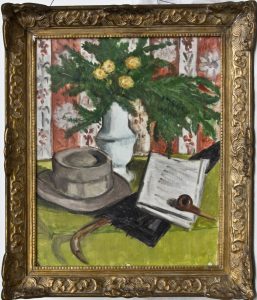
In the case of the painter Theodor Pallady, the still life is a ubiquitous theme in his creation, and in the “The artist’s hat and umbrella”, an oil on canvas glued to the cardboard, we can admire this subject.
Theodor Pallady, “The artist’s hat and umbrella”.
“Still life is represented as such or it can be part of an interior scene, being the only subject that gives it complete freedom of choice. His contemporaries said that the settlement of a still life painting could take days in a row, being transposed on canvas in a few sessions, sometimes even in a few hours. The placement of the objects of a still life painting was an occasion for reflection for the artist, an opportunity to carefully observe the smallest details of each chosen object. By the static nature we can reconstruct almost biographically the environment in which the artist created and lived. Personal objects become the subject of plastic meditation, so we recognize in some still life paintings the gloves or umbrella of the artist, but also the glasses, books or French newspapers, flowers or pipe that the artist used only as an object in his still life paintings,” points out one of the experts who he accompanies us.
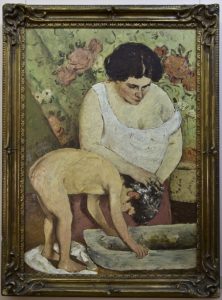
Another common subject in the painter’s creation from the interwar period is the nude, and in the Zambaccian collection we can admire “Two nudes near the fireplace”. “The nude appears from the second decade, but the next decade is probably the peak. Intimate presence, the female nude offers a modern image on a theme loved by artists, the workshop. The composition with several nudes leads us with the imagination in the past, evoking a palace, a space of eroticism for the modern artist who looks to the past of art. The nude is always associated with Pallady with the intimacy of the interior, intimacy that is created by the objects that surround the model sitting in an open position, of reverie”, emphasize the experts.
Camil Ressu, the teacher painter
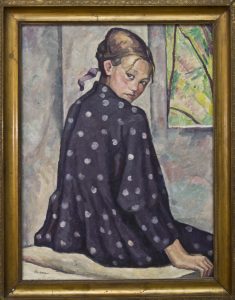
Camil Ressu, “Portrait of a little girl”.
One of the leading artists of the twentieth century, Camil Ressu distinguished himself at the time not only as a painter, but also as a good teacher, being one of the teachers of the Bucharest Academy of Arts and rector until 1941. “The concern for the social environment appears in his opera immediately after returning to the country after completing his studies in Munich and then Paris. The portrait is a genre in which Ressu excelled as we can see in the Zambaccian collection. The most remarkable portrait is the one that presents Luchian “suffering in an armchair upholstered in red velvet, with the body stiffened by a lethal disease”, as the artist remembers. In the same collection we can see the portrait of Zambaccian’s father, as well as the Portrait of the little girl. This girl, represented from behind, turns the head towards the viewer in a spontaneous and fresh attitude. The whole composition is dominated by the dark blue dress with white dots, highlighted by the contrast with the simple, but bright walls of the room in which it is portrayed,” shows our host.
Brâncuși from the Zambaccian collection
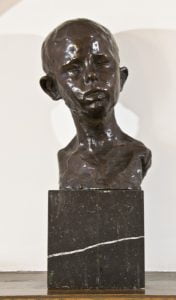
Constantin Brancusi, “Head of a Child”, bronze.
One of the bronze cast versions of the work “Head of a Child”, made by Constantin Brâncuși, is also in the Zambaccian collection, being a rather small work, a work suited to the exhibition inside. Our hosts advise us, in order to form an overview of the subject, to compare the mentioned work with those exhibited in the Romanian Modern Art Gallery. “The physiognomy of the child is a subject that has worried Brâncuși especially in the first period of creation, the one of learning. These portraits made either in gypsum or in patinated bronze, sometimes in several variants, show us the special care that the artist gives to the physiognomic details”.
Portrait of K.H. Zambaccian
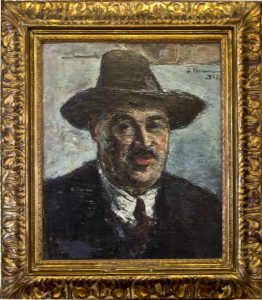
Gheorghe Petraşcu, “Portrait of K.H. Zambaccian”.
And we cannot conclude this presentation without evoking the one who gave us the chance to admire so many masterpieces. It is about K.H. Zambaccian, the art collector who continues to make history because of his passion for everything that is beautiful. “The passion for painting is the basis of a quarter-century friendship between Gheorghe Petrașcu and K. Zambaccian. The portrait of the collector shows us a man in power, dressed in the fashion of time, in a suit with a tie, and on the head with a hat. The portrait is signed and dated, 1927. We note the unmistakable style of the painter, the color placed on the canvas in a thick layer, dominated by dark tones and the contrast between dark and open that highlights the collector’s portrait,” says the host of the Zambaccian Museum.
Acest mod permite persoanelor cu epilepsie să utilizeze site-ul web în siguranță, eliminând riscul de convulsii care rezultă din animații intermitente sau care clipesc și din combinații de culori riscante.
Mod pentru Deficiențe de Vedere
Îmbunătățește vizualurile site-ului web
Acest mod ajustează site-ul web pentru confortul utilizatorilor cu deficiențe de vedere, cum ar fi Vedere Degradantă, Vedere în Tunel, Cataractă, Glaucom și altele.
Mod pentru Dizabilități Cognitive
Ajută la concentrarea asupra conținutului specific
Acest mod oferă diferite opțiuni asistive pentru a ajuta utilizatorii cu deficiențe cognitive, cum ar fi Dislexie, Autism, AVC și altele, să se concentreze mai ușor asupra elementelor esențiale ale site-ului web.
Mod Prietenos pentru ADHD
Reduce distragerile și îmbunătățește concentrarea
Acest mod ajută utilizatorii cu ADHD și tulburări de neurodezvoltare să citească, să navigheze și să se concentreze mai ușor asupra elementelor principale ale site-ului web, reducând în același timp semnificativ distragerile.
Mod pentru Nevăzători
Permite utilizarea site-ului cu cititorul dvs. de ecran
Acest mod configurează site-ul web pentru a fi compatibil cu cititoarele de ecran, cum ar fi JAWS, NVDA, VoiceOver și TalkBack. Un cititor de ecran este un software pentru utilizatorii nevăzători, instalat pe un computer și smartphone, iar site-urile web trebuie să fie compatibile cu acesta.
Dicționar Online
Experiență Lizibilă
Scalare Conținut
Implicit
Lupă Text
Font Lizibil
Prietenos pentru Dislexie
Evidențiere Titluri
Evidențiere Linkuri
Dimensionare Font
Implicit
Înălțime Linie
Implicit
Spațiere Litere
Implicit
Aliniat la Stânga
Aliniat la Centru
Aliniat la Dreapta
Experiență Plăcută Vizual
Contrast Întunecat
Contrast Luminos
Monocrom
Contrast Ridicat
Saturație Ridicată
Saturație Scăzută
Ajustează Culorile Textului
Ajustează Culorile Titlurilor
Ajustează Culorile de Fundal
Orientare Ușoară
Dezactivare Sunete
Ascundere Imagini
Ascundere Emoji
Ghid de Citire
Oprire Animații
Mască de Citire
Evidențiere la trecerea mouse-ului (Hover)
Evidențiere la Focalizare (Focus)
Cursor Mare Întunecat
Cursor Mare Luminos
Citire Cognitivă
Tastatură Virtuală
Taste de Navigare
Navigare Vocală
Informaţii Cookie
Pentru a vă ajuta să navigați cât mai bine, acest website folosește fișiere de tip cookie absolut necesare, iar cu acordul dvs. dorim să folosim și alte fisiere de tip cookie de analiză și produse oferite de Google Inc.
Poţi seta ce cookie doreşti să fie activ de la Setări de confidențialitate.
Citește mai mult
Acceptă
Schimbă setările
Setări cookie box
Setări cookie box
Setări de confidențialitate
Alegeți ce cookie-uri să fie autorizate.
Puteți schimba aceste setări oricând. Deși aceasta poate rezulta în devenirea unor funcții indisponibile. Pentru informații legate de ștergerea cookie-urile vă rugăm să consultați funcția de Ajutor al browser-ului dvs.
CITIȚI MAI MULT DESPRE COOKIE-URILE UTILIZATE DE NOI.
Cu ajutorul cursorului puteți activa sau dezactiva diferite tipuri de cookie:
Acest site va:
Ține minte ce grup de cookie-uri ai acceptat
Acest site web nu va:
Ține minte detaliile de login
Fundamental: Ține minte setările permisiunilor de cookie
Fundamental: Permite sesiunile de cookie
Fundamental: Adună informațiile introduse în formularele de contact pentru newsletter sau alte formulare de pe toate paginile
Fundamental: Ține evidența produselor adăugate în coșul de cumpărături
Fundamental: Autentifică logarea dvs. în contul de utilizator
Fundamental: Ține minte limba pe care ați selectat-o
Funcționalitate: Ține minte setările de social media
Funcționalitate: Ține minte țara și regiunea selectată
Analiză: Ține evidența paginilor vizitate și a interacțiunilor întreprinse
Analiză: Ține evidența locației și regiunii baza pe numărul dvs. de IP
Analiză: Ține evidența timpului petrecut pe fiecare pagină
Analiză: Crește calitatea datelor din funcția de statistică
Reclamă: Adaptarea informațiilor și reclamelor pe baza intereselor dvs. de exemplu conform conținuturilor vizitate anterior. (În prezent nu folosim targeting cookie-uri sau cookie-uri de semnalare)
Reclamă: Adună informații identificabile personal cum ar fi numele sau locația
Acest site va:
Esențial: rețineți setarea permisiunilor pentru cookie
Esențiale: permiteți modulele cookie pentru sesiuni
Esențiale: adunați informațiile pe care le introduceți într-o formă de contact, un buletin informativ și alte formulare din toate paginile
Esențial: urmăriți ce introduceți într-un coș de cumpărături
Esențiale: autentificați-vă că sunteți conectat (ă) la contul dvs. de utilizator
Funcționalitate: rețineți regiunea și țara selectată
Google Analytics: urmăriți paginile vizitate și interacțiunile efectuate
Google Analytics: Urmăriți locația și regiunea pe baza numărului IP
Google Analytics: urmăriți timpul petrecut pe fiecare pagină
Analytics: măriți calitatea datelor funcțiilor de statistici
Publicitate: adaptați informațiile și publicitatea în funcție de interesele dvs., bazate pe ex. conținutul pe care l-ați vizitat anterior. (În prezent, nu folosim cookie-uri de direcționare sau de direcționare
Publicitate: Strângeți informații de identificare personală, cum ar fi numele și locația
Acest site va:
Esențial: rețineți setarea permisiunilor pentru cookie
Esențiale: permiteți modulele cookie pentru sesiuni
Esențiale: adunați informațiile pe care le introduceți într-o formă de contact, un buletin informativ și alte formulare din toate paginile
Esențial: urmăriți ce introduceți într-un coș de cumpărături
Esențiale: autentificați-vă că sunteți conectat (ă) la contul dvs. de utilizator
Funcționalitate: rețineți regiunea și țara selectată
Acest site web nu va:
Amintiți-vă datele de conectare
Google Analytics: urmăriți paginile vizitate și interacțiunile efectuate
Google Analytics: Urmăriți locația și regiunea pe baza numărului IP
Google Analytics: urmăriți timpul petrecut pe fiecare pagină
Analytics: măriți calitatea datelor funcțiilor de statistici
Publicitate: adaptați informațiile și publicitatea în funcție de interesele dvs., bazate pe ex. conținutul pe care l-ați vizitat anterior. (În prezent, nu folosim cookie-uri de direcționare sau de direcționare
Publicitate: Strângeți informații de identificare personală, cum ar fi numele și locația
Acest site va:
Essential: Remember your cookie permission setting
Essential: Allow session cookies
Essential: Gather information you input into a contact forms, newsletter and other forms across all pages
Essential: Keep track of what you input in a shopping cart
Essential: Authenticate that you are logged into your user account
Essential: Remember language version you selected
Functionality: Remember social media settings
Functionality: Remember selected region and country
Analytics: Keep track of your visited pages and interaction taken
Analytics: Keep track about your location and region based on your IP number
Analytics: Keep track of the time spent on each page
Analytics: Increase the data quality of the statistics functions
Acest site web nu va:
Amintiți-vă datele de conectare
Publicitate: Folosiți informații pentru publicitate personalizată cu terțe părți
Publicitate: vă permite să vă conectați la site-urile sociale
Publicitate: identificați dispozitivul pe care îl utilizați
Publicitate: Strângeți informații de identificare personală, cum ar fi numele și locația
Acest site va:
Essential: Remember your cookie permission setting
Essential: Allow session cookies
Essential: Gather information you input into a contact forms, newsletter and other forms across all pages
Essential: Keep track of what you input in a shopping cart
Essential: Authenticate that you are logged into your user account
Essential: Remember language version you selected
Functionality: Remember social media settings
Functionality: Remember selected region and country
Analytics: Keep track of your visited pages and interaction taken
Analytics: Keep track about your location and region based on your IP number
Analytics: Keep track of the time spent on each page
Analytics: Increase the data quality of the statistics functions
Advertising: Use information for tailored advertising with third parties
Advertising: Allow you to connect to social sitesl Advertising: Identify device you are using
Advertising: Gather personally identifiable information such as name and location


 We invite you to walk together in the universe of Zambaccian, the art collector who loved beauty so much that he left us a museum with a unique value.