
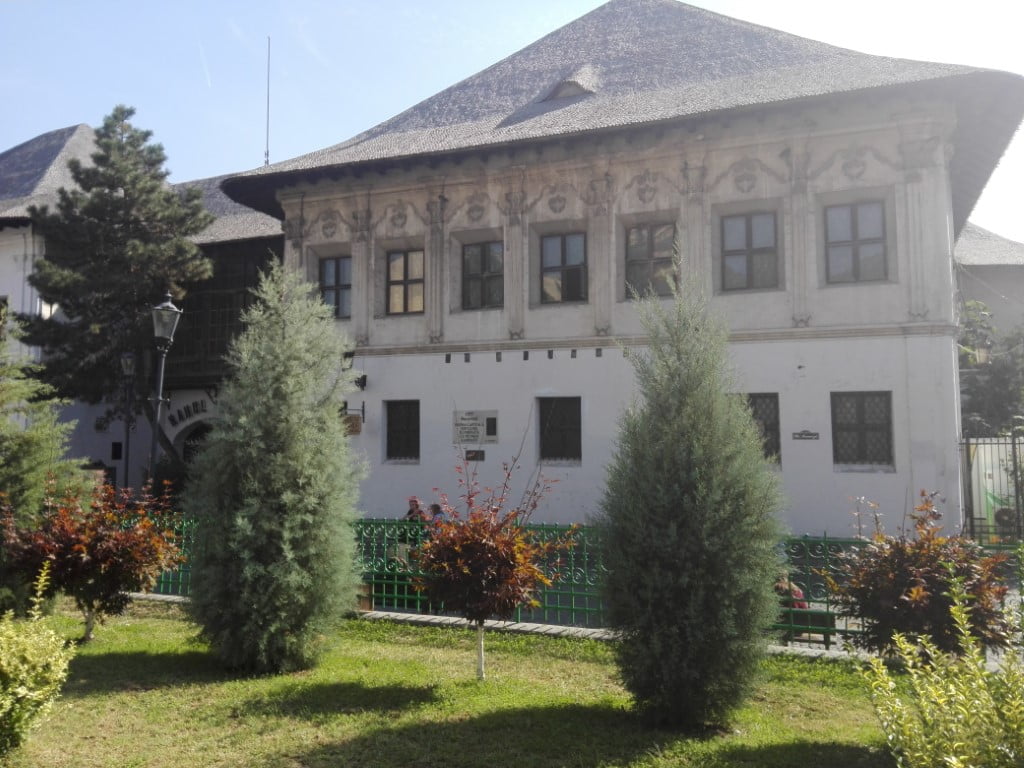
 Bucharest is a blend of architectural styles, and out of this blend resulted a city with a fragrance unraveling its basic tones as you discover it, street by street. Located at the edge of the Ottoman rule, Bucharest preserves even today the traces of an era in which the world was dominated by this empire.
Today we will follow in the Ottomans footsteps, so we need to get ready to enter into a maze of streets, buildings…tales. A maze where is no need of an Ariadna’s thread, since, no matter where you are starting from: The University, Calea Victoriei / Victory’s Avenue, Splaiul Independenţei / Independence Embankment, I. C. Brătianu Boulevard, you will still get out of under.
The urbanistic structure of the city is „tributary” to the Ottoman influences. The Muslim world in the Ottoman Empire’s era strongly influenced the urbanistic tendencies in Dobrogea / Dobrudja, Moldova / Moldavia and Țara Românească / Wallachia. Thus, the settling down process of townsfolks’ (craftsmen and tradesmen), but also of the landowners’ families coming for businesses at the Royal Court, bear the Ottoman signature. It is only natural in the context in which between the Romanian Principalities and Ottoman Empire there were strong economic ties.
The Economic Ties with the Ottomans Influence the Street Network in Bucharest
Even though they never had a pachalic status, these territories were transit areas for the Ottomans, and also for those coming from West to East for commercial interests. On their way to Europe, the East commodities were transiting, on dry land, the Romanian Principalities. The same happened as regards the commodities in the West en route to the East.
And all that gave birth to a street web, formed at that time according to the commercial interest of various fraternities of craftsmen and tradesmen. This way we can also explain the street designations so familiar within the Bucharest nowadays: Lipscani / The Leipzig Folks, Şelari / Saddlers, Blănari / Furriers, Băcani / Grocers, Zarafi / Exchangers, Căldărari / Tinkers, Strada Halelor / Market House Street.
Going on foot on these streets, but also on others in Bucharest, it’s possible for you to find traces left behind by the Ottoman architecture. One case in point are the windowpane-walled houses. Such a house can be seen on the Strada Șelari / Saddlers Street, but also in the Piaţa Romană / Roman Square area. It is true that to the tourist less knowledgeable of the architectural styles, it is rather difficult to identify the windowpane wall, but it’s good to know that the windowpane-walled edifices are an Ottoman heritage.
For those who visited the old areas of a number of Western cities, the street layout they discover in the Old Center of the capital of Romania may seem to them as being of Western influence. The cities in the west also are possessed, in the central area, of pedestrian thoroughfares developed along the period buildings.
Unlike the Western world, where we find a certain Germanic harmony, the streets being aligned and dominated by buildings of Gothic or neoclassical influence, in Bucharest, to the tourist, a maze of an Oriental origin is being revealed, with passages hidden among twisty small streets.
The First Stop: Hanul lui Manuc / Manuc’s Inn
We will proceed „in the footsteps of the Ottomans,” walking down slowly on Lipscani. We will get onto Strada Șelari / Sadlers Street (where I have already told you that there is a windowpane-walled house), crossing over Gabroveni Street, Covaci Street and Strada Franceză / French Street and reaches Dâmboviţa riverbank of, on the Embankment called Independenţei / Independence.
We will be heading toward Covaci Street and thus will get right into Piaţa Sfântul Anton / Saint Anthony Square, next to Biserica Sfântul Antonie Curtea Veche / Saint Anthony Church Old Court and Hanul lui Manuc / Manuc’s Inn. Our target is this very inn, a building heavily laden with history.
Stopping at this Inn has a very clear motive, namely that this type of construction highlights the best the Ottoman influence in Bucharest’s architecture. Although in today’s context, in which it is fashionable to introduce yourself as a convinced Westerner, bringing into discussion the Balkan-Oriental marks may disturb, history shows us that such a beautiful city as this one owes a lot to that period when it was a picturesque town. For many centuries Bucharest was a settlement where a blend of nations existed. Alongside Wallachians, Turks, Armenians, Greeks, Bulgarians, Albanians and Jews lived here as well. And their existence on these lands can be felt at every step of the way, even today there being many visible traces of their living.
The Inn is a part of the eloquent evidence of the Ottoman influence. Perhaps you wonder about the way this Inn came into being, the way the construction was erected right in the middle of the town. We find the explanation in the history of Bucharest. We should not forget that this area was a transit one, making the commercial connection between West and East, and it was impossible that the merchants’ journeys on these lands would remain without traces.
In the tumult of this life, the inns emerged naturally, being built according to an already existing pattern. We’re talking about the Oriental caravansaries constituting the base of the new edifices.
During their long journeys, the merchants needed places to rest, in which to be able to shelter not only their commodities, but also for their families, servants, animals.
Rectangular-shaped buildings, the inns where designed with an opening toward the inner court only. The heavy gates shutting this unique opening where surrounded by thick walls meant to withstand any attack coming from the outside. The inner court included arched stores, but also deep cellars where the precious commodities were hidden. The chambers for rest were not absent either.
Coming back to Hanul lui Manuc / Manuc’s Inn, it’s interesting to discover the history behind this spectacular building. The Inn was erected by Manuc Bei, a rich merchant, who amassed his wealth out of commerce, but also of usury. Manuc Bei was someone whom today we may call a „banker,” since he would lend money and receive back the lent amount plus the interest.
Manuc Marzaian (1769-1817) was of an Armenian origin, and his journeys led him through a number of places in Europe.
Arriving in Bucharest in 1806, Manuc makes the decision to build this Inn. The works last until around 1808, because of the political situation during that period.
There are rather many legends about the Inn. Regarding Manuc Bei, it is said that actually he was a spy who played an important role in the Russo-Turkish war. Moreover, there are historical sources indicating that the Bucharest Treaty (1812), which brought to an end the Russo-Turkish war, was signed right at Manuc’s Inn.
A description of the Inn done in the 19th century shows that in the underground the construction was possessed of 15 arched cellars. Moreover, the ground floor included 23 stores, two large saloons, ten warehouses, rooms for servants, kitchens and a tunnel which could fit around 500 persons. The building features one floor, where 107 rest chambers were arranged.
The legends woven around this symbol-building in Bucharest are numerous, and one of them makes reference to a large treasure which would be hidden here. It is said that Manuc hid his riches throughout the Inn’s mazes. Beyond these stories, important is the beauty of the building and its importance in bringing into discussion the Ottoman influence on Bucharest’s architecture.
Toward Hanul cu Tei / The Linden Inn
We will leave behind the legends related to Manuc Bei and return to Lipscani, to stop for a few moments in front of the The National Bank Palace. At one time here was enthroned Hanul Şerban Vodă / Prince Șerban Inn, erected between 1683-1685. Although it was remodeled after the 1804 fire, it was demolished in 1883.
On our way toward another wonderful place in Bucharest, Hanul cu Tei / The Linden Inn, we will make another stopover to admire Hanul Elias / Elias Inn (Patria / Fatherland), located behind Biserica Sfântul Ioan Piaţă / Saint John Plaza Church. The building was restored and illustrates very well the Ottoman influences in the first half of the 19th century. The historical sources prove that, in spite of the passage of time, the building preserved its original aspect.
We leave behind this edifice, and we are heading on the I. C. Brătianu Boulevard toward Hanul cu Tei / The Linden Inn, which we will find proudly rising up, somewhere between Lipscani and Blănari.
Built in the year 1833 by Anastasie Hagi, Gheorghe Polizu şi Ştefan Popovici, the edifice survived the passage of time and today presents itself to us in all its splendor.
Just as Manuc’s Inn was also known as „Hanul Curtea Veche / The Old Court Inn”, Hanul cu Tei / The Linden Inn bore the name „Hanul de pe uliţa cea mare a Marchitanilor / The Inn on the Great Peddlars’ Thoroughfare.“
The initial destination of the building was a commercial one. The merchants who erected the Inn owned stores there, and they have thought out everything as a link between their businesses and others they took over. The rectangular-shaped Inn was featured on both sides with 14 stores on each one (14 on the East side and 14 on the West side), and also with two entries making the connection between the two streets it joins together: Lipscani and Blănari.
Meanwhile, the building changed its initial destination, at some point turning into a bankers’ location. Today, Hanul cu Tei / The Linden Inn is a place which each tourist coming to Bucharest should admire, as he should admire other wonderful places in the capital of Romania as well.


