
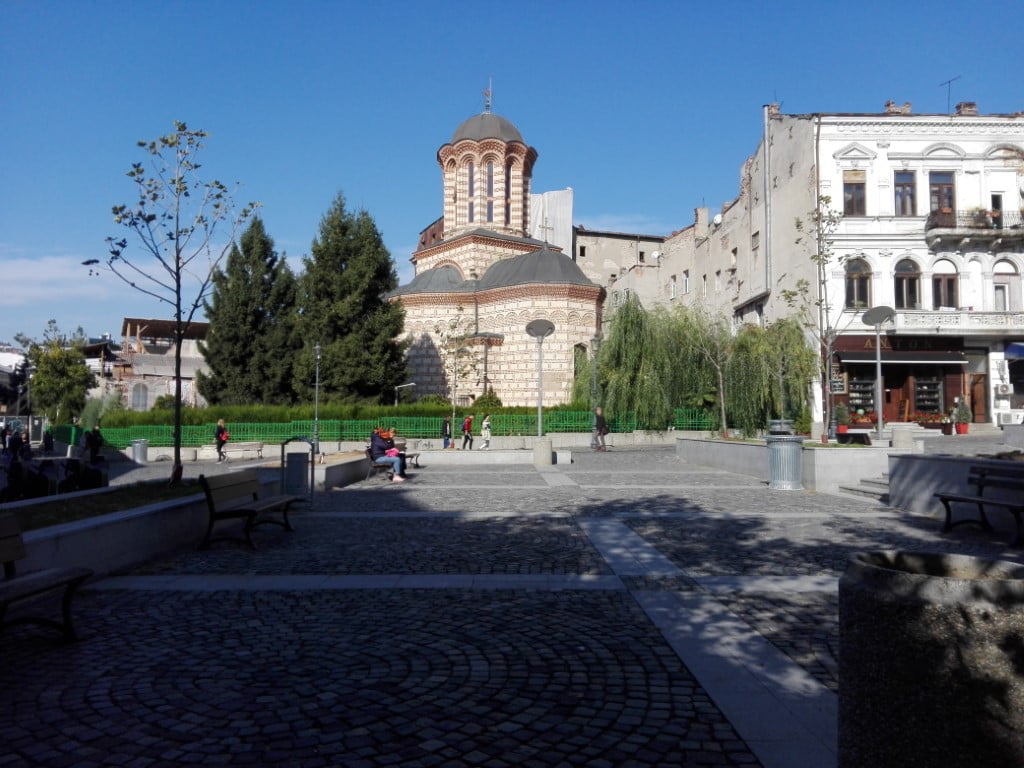
 Bucharest is the perfect city in which the tourist passionate about history can satisfy his curiosity to find out new information about past times and to see places that remind of the times of the rulers who influenced the lives of those who settled in these places.
The tourist among the vestiges remains today at the Old Court, a magnificent archaeological site where researchers work hard to rehabilitate and bring it, in all its splendor, to the public attention.
It is amazing to find that such a place is in the middle of this metropolis. Equally amazing are the stories that accompany the Old Princely Court.
The place where Bucharest developed
The works on this archaeological site have been carried out since the communist period, in the 70s, the specialists making a series of important discoveries. At that time it was believed that only two cellars and a few isolated foundations remained, but during the excavations, archaeologists have managed to highlight two medieval fortresses.
On this occasion, the outlines of the Princely Palace from the 16th to the 17th centuries were established and those of an arched room, located on the ground floor of the edifice.
“High walls of 8-10 meters have been identified in several areas of the archaeological reserve, allowing the determination of certain elements regarding the ground floor and the floor of the monumental building”, writes Simion Săveanu, in his 1973 work, “Enigmele Bucureștilor”.
The work of the researchers revealed that the royal residence has expanded greatly over time. Thus, if in the 14th century it occupied an area of 160 square meters, at the end of the 17th century it reached an area of approximately 2,000 square meters. Simion Saveanu appreciates that this is the largest medieval construction in the Walachia.
The excavations have also brought to light numerous vessels, dating from the 15th century. These include kaolin bowls, oriental dishes, burnt clay mugs, etc. Also, was found a coin issued in 1527 and … a 17th century dental pliers.
The princely edifice was gradually brought to the surface, and at present efforts are being made to valorize these vestiges. It is very important for the city that the whole complex be rehabilitated and become a central point on the historical tourism map.
Stories from the Old Court
The medieval fortresses and palaces, which once housed certain centers of power, were witnesses of stories that went back centuries. The same thing happened at the Old Princely Court. Complex histories are linked to this building.
One of them has in the center the cruel Mrs. Chiajna, about whom she is said to have held with her iron hand the reins of Walachia. The cellars of the Old Court witnessed many of her barbaric deeds. Compared by some historians with Salomeea, Mrs. Chiajna ordered the bringing in chains to the royal houses of the claimant to the throne, which she later killed and exposed his head on a silver tray at a banquet offered in honor of the boyars.
The cruelty appears to have been transmitted to her by her ex-husband, Mircea Ciobanu, who is said to have mercilessly killed over 200 boyars.
Even the passion dramas were not missing from the Old Court. Miss Ancuta, the daughter of Mrs. Chiajna, was the heroine of such a drama, which was described by the writer Alexandru Odobescu.
At her mother’s command, Miss Ancuta accepted to marry a wealthy man much older than her, very ugly. Thus she trampled on her feelings, being in love with the son of a boyar. During the religious wedding ceremony, the betrayed lover stepped in the middle of the wedding, set fire to a black cloth and shouted, “Get lost, my deluded hope!” The bride could not resist the pain and fainted.
We will leave the Old Court behind and we will go to other vestiges that we will talk about in another article.
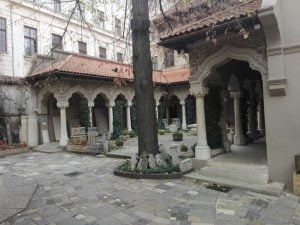
Thus, at the intersection between the French Street and the Post Street, we will discover the Church “Sfântul Dumitru Poștă”, and nearby there is another historical monument building in which the Post Hospital once operated. Today it houses, in one wing, the National Institute of Rehabilitation, Physical Medicine and Balneoclimatology, and in another wing the Comedy Theater. On the other side of the street is the National Museum of Romanian History. Also, at the confluence of Post Street with Stavropoleos Street, we find the Church of Stavropoleos Monastery.


