

 We return to the mysterious streets with capital names, places that have allowed us, many times, to escape from the everyday life and to enter a world where the houses tell us the history of the city. Calea Dorobanți usually radiates in the morning sun: light, agitation, activity. The shops display their windows, the customers of the banks busily rush and maintain an intense traffic, which became emblematic for the entire Bucharest. From place to place, however, true space gates, Madrid, Washington, Lisbon and Brussels streets allow access in a completely different world.
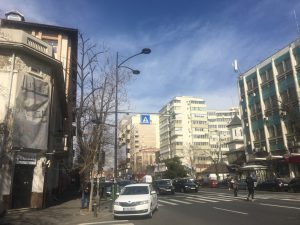
From every angle we approach the neighborhood with streets with names of capitals and countries, the sudden passage from the tumultuous agitation to the settled peace, with accents of siesta specific to the small bourgeoisie, always shock.
This time, from Calea Dorobanți, we enter Lisbon, Lisbon Street.
The area with housing for officials
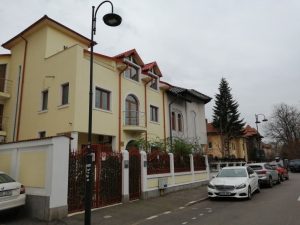
It’s a small street. It branches off relatively quickly, forming a kind of market where an elegant small park is arranged. Lisbon intersects Brazil Street and “melts” in Brussels Street.
The buildings here are built at the beginning of the twentieth century, with the systematization of this part of town by “Dorobanți Parceling”.
Under the signatures of the architect Dimitrie Mohor and the engineer Andrei G. Ioachimescu, appears, in 1914, the layout of parceling the area through which houses could be made after relatively predetermined projects (type), destined to the officials of the Ministry of Finance and to the officials of the War Ministry. The area covered included an area that today corresponds to Brazil, Brussels, Madrid and Washington streets.
On this parceling, up to 1916, the year in which Romania entered the First World War, eight buildings were built. In 1920-1921, a second stage of project development was carried out, with approvals for 60 buildings being required. Unfortunately, the arrival of the Second World War has limited the constructions. However, from that time we still have an important legacy that we can admire today.
Lisbon Street bears the mark of the architect Dimitrie Mohor
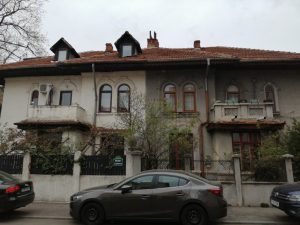
Returning to Lisbon Street, it must be said that the houses here retain the characteristics of the style of architect Dimitrie Mohor. He frequently used, in his creations, the defining elements of the neo-Romanian style, such as the wooden pillars of the gazebos, counterforts, bay windows etc. The architect Mohor was the author of many plans of the type dwellings on this street.
Dimitrie Mohor was the chief architect of the Communal Society for Cheap Housing, and during this time, the construction of many systemized areas of the city was carried out.
Moreover, Mohor is one of the architects of the generation that determined the maturing of the native influences in the architecture. As I mentioned before, he was dependent on the Neo-Romanian style.
An intimate street with lots of mystery
Due to this dominant style, a unit of the Lisbon Street space is observed. The feeling of unity is accentuated also by the massive villas from numbers 1 and 2, located on both sides of the park.
A special touch is given by the imposing building from the number 3, which presents elements and decorations of neoclassical source and which contributes with a note of variation.
The arrangement of the buildings in the layout parceling, but also their appearance as a peasant fortress gives intimacy and a mystery note to each house and street in its entirety. The planning of the arrangement of the houses bears the responsibility for “breaking the rhythm”. The street is clearly delimited by the bustle of the neighboring boulevard.
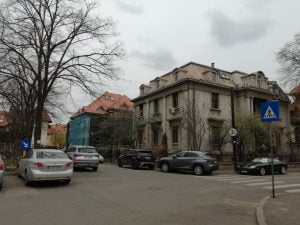
The way in which the architect thought the whole plan of this area allows to increase the free space. Moreover, a free view is provided for movement. The designer decided to withdraw the buildings more than usual from the alignment, thus forming a real square.
The architectural solutions used in the area allowed, subsequently, to create some spaces with multiple functions. In addition, they allowed the development of the concept of “garden city”, which had already appeared in the architecture of the time. This explains the presence of the small park in the middle of Lisbon Street, which, in turn, creates an intimacy and offers those who live in the area the opportunity to socialize or stop for a minute.
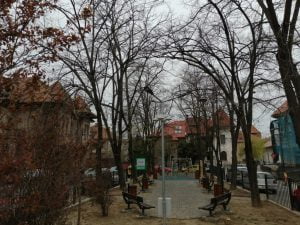
And the tourist walking through the neighborhood can take a break from the bustle of coffee shops and exclusive shops on Calea Dorobanți. It has the opportunity to admire, in peace, special elements of architecture, extraordinary ornamental details and to enjoy the shade offered by the generous vegetation.


