

 The month when the cherry trees are in blossom leads us to the street that reminds us of the country where Hanami has been a tradition for centuries. We will walk today on Tokyo Street. It is true that we will not have the scent of sakura trees that begin to fill the parks of the Japanese capital, but we have the privilege of discovering a rich street in houses with a special architecture.
From Iancu de Hunedoara Boulevard, London and Rome streets start in parallel, forming a kind of staircase. The first step is Tokyo Street, the others being Oslo, Bern and, further on, Washington and Hague. We walked on each of these streets. For the first month of spring Tokyo Street remained to be visited.
We isolate ourselves from the noise of the large boulevards
The row of houses on the side with even numbers totally isolates the street from the crowded and noisy world on Iancu de Hunedoara Boulevard or the insistent traffic on Roma Street. As soon as we walked on Tokyo Street it seems that we have reached another realm. We can experience this sensation on all the streets in this area but, on those near the great boulevards, the feeling of “breaking” with the rest of the city is much stronger.
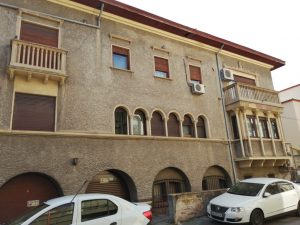
We will focus initially on the part with even numbers. And so, from the direction of Roma Street, at number 14, we discover a magnificent villa, classified in the category of historical monuments. The massive construction has ground floor and two floors. The entrance door has the graceful arch of Mediterranean origin, and the windows at the first level have the arches specific to this style. Also, the capitals of the columns are decorated with plant motifs.
From the classic decorated balcony, you are waiting for Rosina to appear, from Rossini’s opera “Barber of Seville”, to listen to Count Almaviva’s declaration of love.
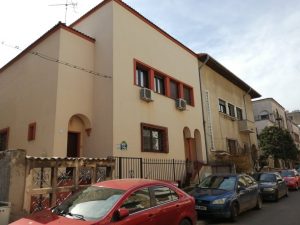
The adjacent villa, the one at number 12, is also a historical monument. Although sober, the construction has a combination of Mediterranean decorative elements – the frames of the door and the windows on the ground floor – with Art Deco – the windows of the first floor – while the short fence, combination of ironwork with lace masonry, reinforces the exotic note.
Tokyo Street is full of buildings in the category of historical monuments. This is also the case of the villas from numbers 10 and 8, which alternate the Art Deco and Mediterranean styles. At number 8, the laced hardware adorns the fence and the balcony, and, in a place with the oval frame of the entrance and with the arches from the windows, highlights the mystery note of the building.
If on the side with even numbers we meet successively the Mediterranean and modernist styles – Art Deco, on the side of street with uneven numbers we find alternatively the Neo-Romanian and Mediterranean styles.
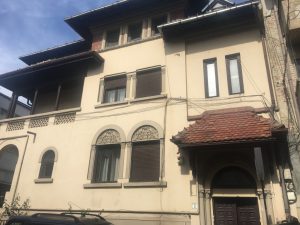
The villa from number 3, historical monument, with high ground floor, first floor and attic is built in a clear neo-Romanian style with open arches and decorations with zoomorphic motifs on the windows, wooden inserts on the terrace and an apparent brick belt under the cornice.
At number 11, another historic building, the style of the building is typical Mediterranean.
Between these houses, almost glued together, the villas from the other numbers alternate and borrow elements from these styles: massive, sober, with rectangular balconies without too many ornaments.
The small courtyards are delimited by low fences and give the impression of a residential park with many common spaces. This gives rise to a detachment from everyday life, a detachment specific to the predominant architectural style (Mediterranean) on this street, an intimacy that becomes complicit and with the occasional passerby encouraged to admire and enjoy the peace of the place.
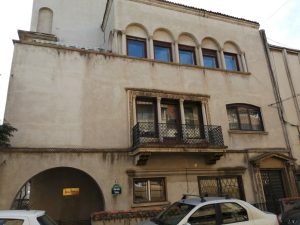
These villas, built in the first half of the twentieth century, are the exponents of a period of economic development that also brought to Bucharest a cultural advance and allowed the emancipation of the population that chooses as travel destinations other regions than those of Western Europe. The effects remained visible especially in constructions and architecture. This is partly explained by the appearance of the public’s taste for mysterious and solar buildings similar to those on the Spanish or Portuguese lands. Added to this is the affinity of architects such as Gheorghe Șimotta or George Damian, from whose drawings real Moorish jewelry appeared in the city.


 - Tokyo Street)