
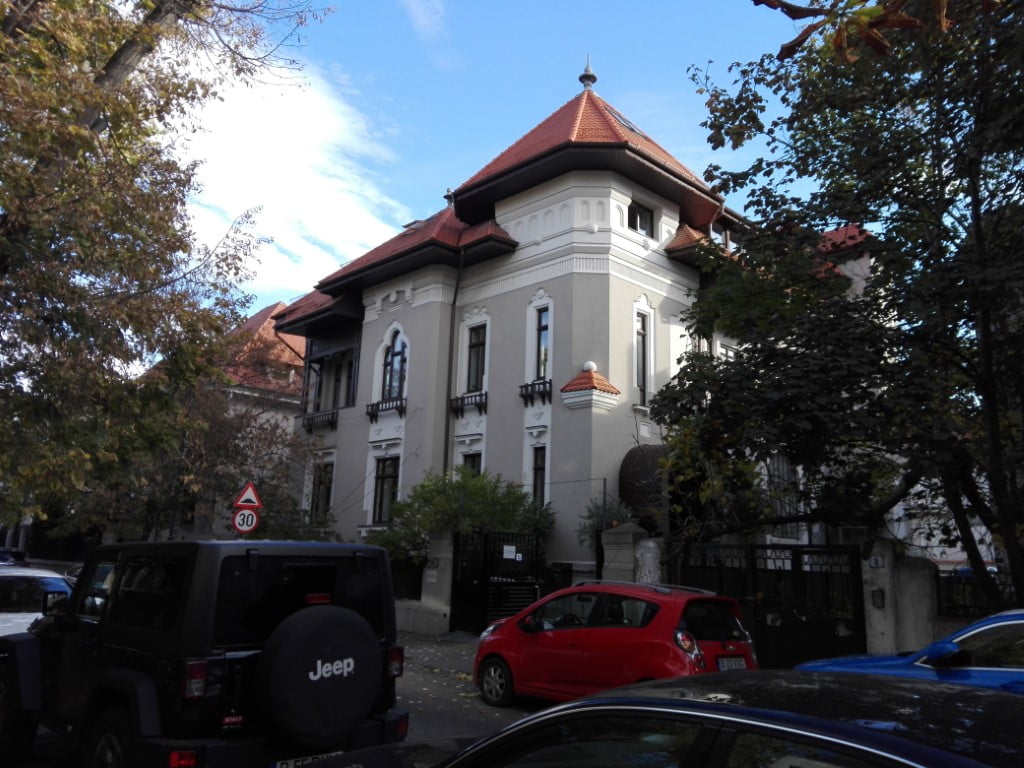
 At the beginning of December in Bucharest, when still “The autumn begins with dawn fog”, and the streets of the city seem that “All are now returning to their core” it could be said that the weather of the traveling tourist was long ago or that a rescheduling is required for a future season.
However …, we leave Quito Square and arrive on Prague Street, in the middle, in front of the historical monument building – white villa, magnificent from the number 11 that we talked about at the time. Here the intersection with Belgrade Street is formed. The small street connects with London Street, parallel to Warsaw Street and Washington Street. And so we complete a corner of the street grid with the names of countries and capitals of the “Filipescu parceling”.
And on Belgrade Street we have a meeting with … history
But before talking about the villas in the category of historical monuments we meet here and which bear testimony to the beginning of the 20th century, an era of economic flourishing in which people built beautifully without threatening the wrath of the events that followed: Second World War and the communist period, we will listen to the stories that the houses here tell us one by one.
And not by chance did I mention the period of the communist regime, a period in which this neighborhood escaped seemingly miraculous from the spectrum of systematization strayed on the city during the 80s.
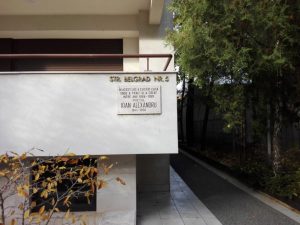
On Belgrade Street, at number 5, we find a memorial plaque that shows us that there was a building where he lived and created for thirty years, during the years 1968-1995, the poet Ioan Alexandru (1941- 1996).
It is important for all today’s generations and those who will come to find out that the poet, the essayist, the university professor, Ioan Alexandru maintained the Christian-Orthodox conscience of the Romanians in a regime that valued atheism. Moreover, he was in the first ranks of the events of December 1989, events that marked the end of this period.
His activity was appreciated by Americans who, on August 31st, 1993, flew the “Old Glory” flag on the building of the United States Congress, in honor of Romania, which was then received by the poet Ioan Alexandru, in gratitude for the courage, resistance and Christian testimony manifested in its entire activity.
“With the measure of love towards my own people I will be measured, valued or forgotten by those who will come,” the poet confessed, and his followers did not forget him: the memorial plaque mounted visibly reminds us of him, as the season and the vegetation send us to the lyrics that belong to him, from which we quoted at the beginning of our walk on Belgrade Street.
Currently, an elegant, bright, modern and sober building stands in the place of his house, in the architectural tone of the street.
The neoclassical and neo-Romanian styles give unity and character to the buildings on Belgrade Street
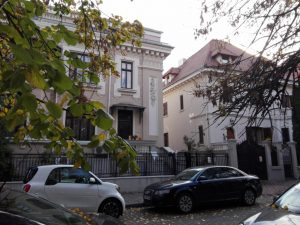
We take a walk on Belgrade Street and thus discover that, on the side with numbers with a husband, a string of buildings classified as a historical monument are tied. The houses from numbers 4, 8, 10-12, and 14 fall into this category.
A mix of neoclassical and neo-Romanian styles is partially devolved after the thick curtain of trees that the proximity of Bucharest winter has not convinced them to give up the foliage permanently and gives the street a mysterious and romantic air.
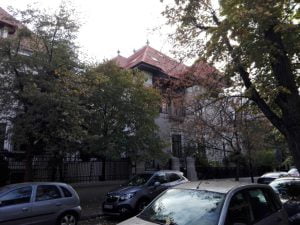
Robust, sober, majestic, with lace masonry ornaments on the windows and the balcony with details of neoclassical origin, the villa at number 14 is a preamble to the buildings on London Street.
The sister villas from the numbers 10-12, built in the same neo-Romanian style, as the one from the number 8, bring the specific atmosphere of the peasant fortress.
All the buildings on the street, whether they are classified in the category of historical monuments, or not, whether they have the same number of floors or not, fall under the same height regime specific to the area, and this feature gives unity to both Belgrade Street and the whole neighborhood.


