
 Ion Mincu, one of our great personalities, has remained in history as the creator of the “national style” in the Romanian architecture. Many of the changes that Romania’s image has undergone are related to the name of this architect, engineer and teacher. Ion Mincu significantly contributed to the evolution of the Romanian architecture, as well as to the development of the national school of architecture.
His merits were recognized and, starting with 1953, the University of Architecture and Urbanism of Bucharest bears his name.
When it comes to such a personality we should, every time we have the opportunity, present the architectural work signed by Ion Mincu. In this way we have the chance to discover the man and the artist who worked for the modernization of these regions and to understand the reasons that made him fight for the development of a “national style” in architecture also.
Ion Mincu, the church restorer
Ion Mincu was the most important representative of the neo-Brancovan style, having trained many generations of architects. Thus, he gave the opportunity to many Romanian towns and cities to acquire their own identity. This is the case of Bucharest. In fact, many of the great architect’s projects are linked to the capital city of Romania.
One of his most important endeavours presents Mincu as a church restorer.
Churches are part of the identity of our people. They bear witness of the Romanian people’s evolution, and speak about the formation of Romania. Through century-old places of worship, we succeed in keeping our history alive and discovering our roots.
Ion Mincu fully understood the importance of these monuments and therefore decided to contribute to their salvation.
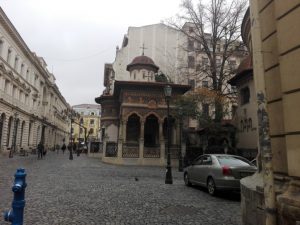
The fact that today we can visit the “delicate construction”, as historian Constantin C. Giurescu called the Stavropoleos Church, is largely due to the great architect.
After decades when the place was left to ruin, Ion Mincu started the restoration works in August 1904. He had been making plans to restore this building since 1897, but it took him a long time to find the support he needed to put it into practice.
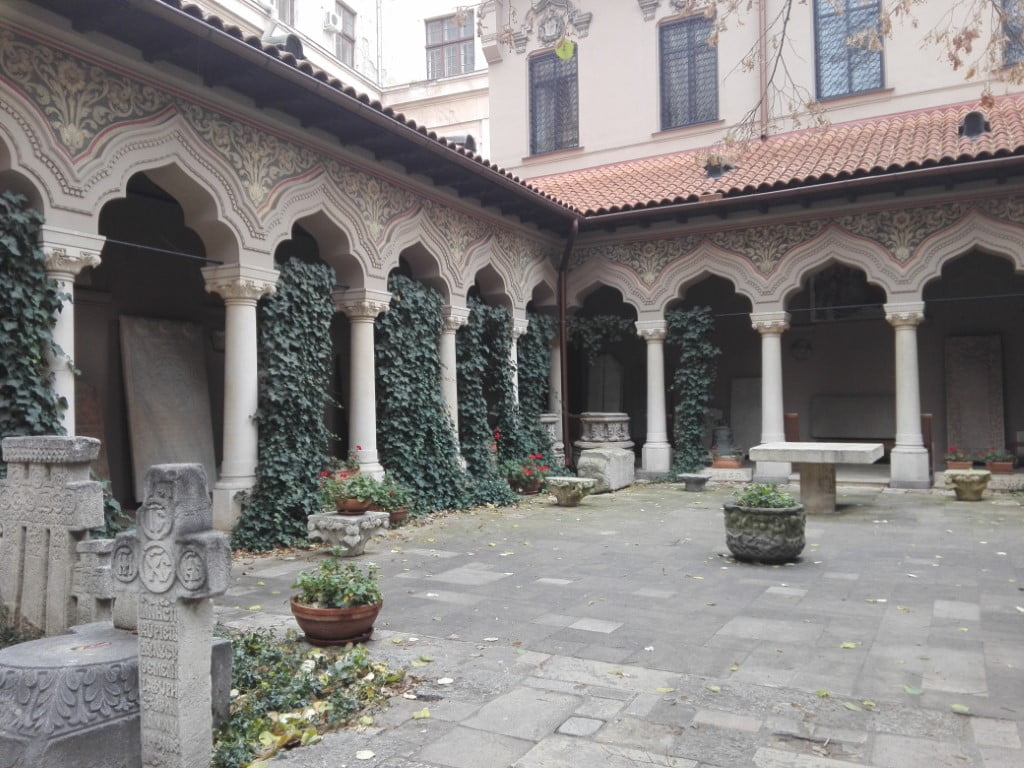
Mincu was the one who conceive both the restoration of the church and the construction of a building resembling the Stavropoleos Inn, which became a museum later on. In the “lapidarium courtyard” of Stavropoleos, visitors have the opportunity to discover stone decorations and crosses, tombstones coming from various Bucharest churches that disappeared from the historical downtown area as the city developed.
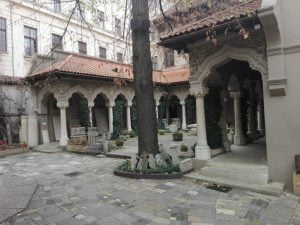
The complete Stavropoleos ensemble does not include only the church and the lapidarium. There, tourists have the opportunity to discover also a special library with many volumes of theology, art and history. Inside the library, there is also an important collection of old books and manuscripts in Greek and Slavonic, printed in the 17th and 18th centuries.
Moreover, the Stavropoleos Church has a rich collection of ancient cult objects.
Returning to the project achieved by Ion Mincu, we must add that after the death of the great architect in 1912, the works were taken over and resumed by one of his students, Alexandru Zagoritz.
Ion Mincu imposed the neo- Brancovan style
As we have already said, Mincu was a strong promoter of the neo-Brancovan style, which he imposed in our architecture. Moreover, the great architect designed many buildings in Bucharest, emblematic of this style. This category includes the High Road Pub, the Lahovari House, the Monteoru House, the Vernescu House, the Central Girls’ School etc.
One of the most spectacular constructions realised by Ion Mincu remains the Lahovary House. The building was designed by the architect at the request of General Iacob Lahovary. The works began in 1886 and resulted in the first building erected in neo-Romanian style.
This building we can still admire bears the imprint of the style promoted by the great architect.
Ion Mincu perfectly combined in his work elements from the Byzantine style, ethnographic motifs from the peasant culture and modern architectural motifs. Through this unique combination he imposed a new style, which would become defining for our architecture for half a century.


