
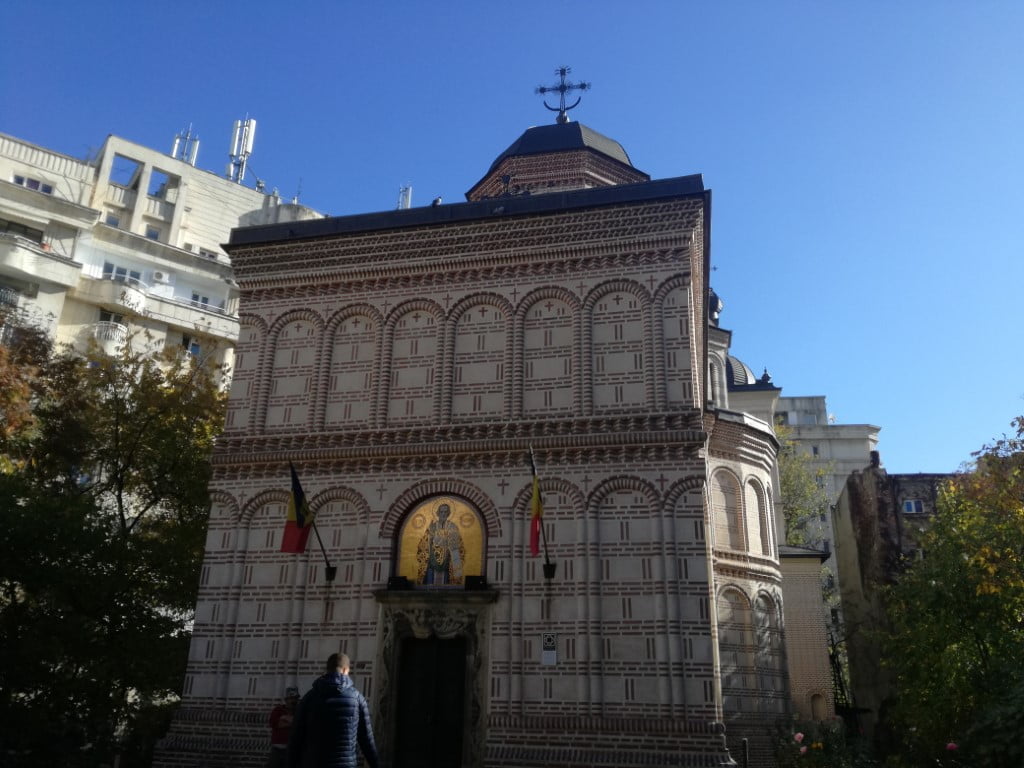
 Across the road from the “The Assumption of the Mother of God” Church – Sapienței we see today Prince Michael’s Monastery rising. And to this place of worship many stories are related, fascinating to the tourist passionate about history. We set out to retrace the footsteps of the Geto-Dacians in Bucharest, and thus during our trip we shall will try to find as much information as possible that can help us in the proposed approach.
The historic sources present testimonies regarding the populations that lived in the area where Bucharest is lying today. Before starting our voyage, we did some documentation and thus we learned that we should start our journey from Prince Michael’s Monastery.
The monastery the communists wanted to hide
Well hidden among the communist blocks of flats, Prince Michael’s Monastery defies all the hardships it has undergone throughout time and appears to the viewer in all its splendour.
Founded by Michael the Brave himself, in 1594, the monastery includes in its structure the grandeur of this ruler who first united the Romanian Principalities in 1600, when in a proclamation Michael the Brave called himself “prince and lord of the whole Wallachia and Transylvania and Moldova”.
The first impact, when you see the church, is a powerful one. The shape of the raised trilobe gives you the feeling that the place of worship rises to the sky. The facade of the church is also spectacular, the sturdy walls being decorated with a series of arches, framed by rounded pieces of brick. Unlike other places of worship, Prince Michael’s Monastery also draws the attention by the striking colours covering the entire construction, colours given especially by the apparent brick framed by plastered areas.
The beauty of the building is overshadowed by the sensation you feel when you enter the church yard. Even if it has preserved its greatness intact, Prince Michael’s Monastery seems to bear the traces of the pain felt by the one rooted out from one’s original place.
A vague memory of the Prince Michael’s Monastery Assembly
The place where we find this place of worship today is not the one chosen by Michael the Brave when he founded the church.
Before the communist regime adopted the policy of hiding places of worship from the visual perimeter, the monastery dominated the right bank of Dâmbovița River, where Prince Michael’s Hill sheltered an entire compound that had this very church in its centre.
Prince Michael’s Monastery Ensemble was a true historical jewel, where the stories of those who lived in these lands were gathered.
We first promised that we shall travel today in search of the Geto-Dacian traces in the capital city. Well, these traces existed exactly under Prince Michael’s Monastery, where archaeologists made a sensational discovery, but which the communists managed to bury again.
Until 1985, the year when Prince Michael’s Monastery was relocated, in the courtyard of the Prince Michael’s Monastery Compound there was an important archaeological site, clear proof of the fact that there was an ancient Geto-Dacian settlement dating back 3000 years. In this site archaeologists discovered furnaces for pot burning, Dacian cups, knives, rotary grinders.
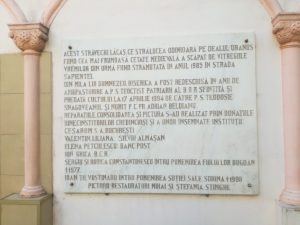
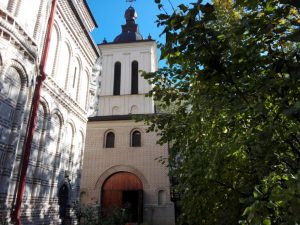
When they decided to move the church together with the bell tower, the communists demolished all the surrounding buildings. It can be said that a miracle saved this place of worship from destruction, although it was initially included on the list of buildings that had to be demolished. Only the pressures of the historians of the time determined the regime to give up and to accept the 289-meter slope translation of Prince Michael’s Monastery.
The archaeological site there had no chance to continue, so today we can no longer enjoy watching live historical evidence of great importance.
It is a shame that in the courtyard of the site founded by the ruler enemies called “Malus Dacus” (The Evil Dacian) and considered by history as a worthy descendant of Burebista and Decebal, we no longer find the evidence attesting our ancient origin on these lands.
Traces of several Geto-Dacian settlements have been found in other neighbourhoods in Bucharest, such as Dămăroaia and Herăstrău. However, the discoveries were not properly exploited and were not valued in the form of sites that we could include in the tourists’ circuit.
So, if we want to discover the truth about these places, I invite you on a new journey. The destination is the National History Museum of Romania.


