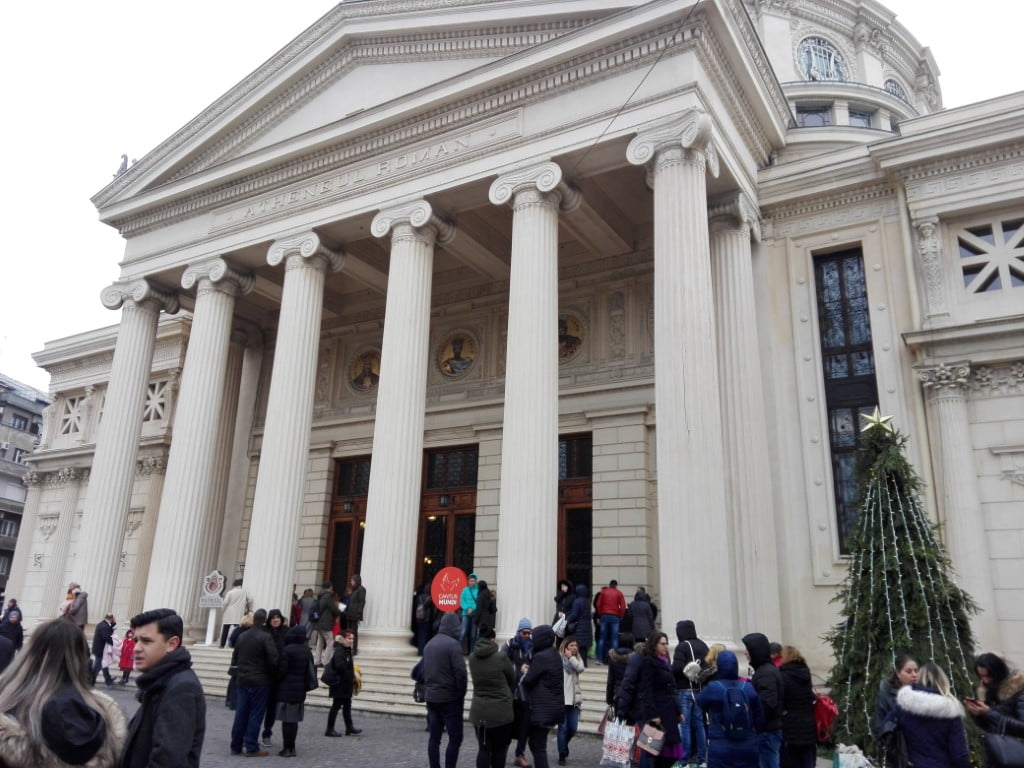

 The marks of foreign architects are visible throughout Bucharest. Today we will follow Albert Galleron, a Frenchman whose name is linked to one of the emblematic buildings of the Romanian capital: the Romanian Athenaeum.
The personality of an artist, because architecture is also an art, is best discovered by admiring his work. We will meet Albert Galleron (Paul Luis Albert Galleron, 1846-1930) through his extraordinary work, through the architectural jewels that enrich Bucharest.
Before heading to the Romanian Athenaeum, we will make some stops to watch a small part of the magnificent heritage that the Frenchman left for Little Paris. In addition, we will have the opportunity to discover other extraordinary places that any tourist, who comes to Bucharest, must see.
It starts from Lenș – Vernescu House
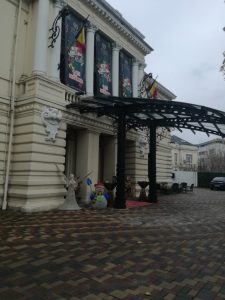
We will do the first stop at Lenș – Vernescu House. Many will jump to say: why Lenș – Vernescu House? Well, few people know that Albert Galleron intervened in the period 1883-1886 with a series of changes to this building, changing the original plan developed by architect J. Freywald. It cannot be said that the architectural jewel on the Victory Avenue, number 133, is emblematic of the style imposed by Galleron, but it must be remembered, given that many of the buildings of the 19th century are under the strong French influence.
And if we have just started the route from Lenș -Vernescu House, we will take the opportunity to enjoy another architectural wonder in the area: Ghica- Grădișteanu House, located at the intersection between Victory Avenue and Nicolae Iorga Street. The 1884 building is based on the plan realized by Jules Berthet, and the construction was erected by the French architect Louis Blanc.
The tourist who went after Galleron can have a few moments of peace on the alleys of the Nicolae Iorga Park or at the shelter of the Saint Nicholas Tabacu Church, a place of worship whose story I told you in a previous article. The church is included in a recommendation made to a tourist passionate about architecture for several reasons: it is a church historical monument, still preserves part of the painting by Gheorghe Tattarescu, and the iconostasis dates from the 19th century.
Towards Dionisie Lupu Street
Once you leave this area, dominated by a certain quietness broken only by the horn of some cars rushing to follow Victory Avenue, we will venture into the city. We will turn left onto Dacia Boulevard to reach the Roman Square. We will pass the building with columns and we will go to the intersection with Dorobanți Way. From here we will take you to Lahovari Square, where we have the opportunity to admire the House of Scientists and the statue of the one who gives the name of this place (Alexandru Lahovari). But our goal is to reach the Dionisie Lupu Street.
Right from Lahovari Square, you enter on Dionisie Lupu Street. A true open-air museum, the area offers the opportunity to admire, at number 74, a building erected according to the plans of the architect George Damian. It seems that Marin Preda and Catinca Ralea once lived in this building. Below this building, we will discover the house where Gheorghe Țițeica lived, and at numbers 70-72 we have the opportunity to admire a splendid house with caryatids.
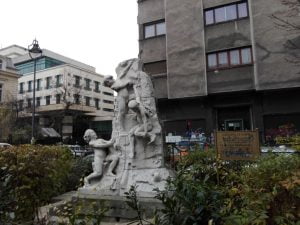
And if we are still in the area, we will take advantage to admire the work “Fountain with children”, signed by the sculptor Ioan Iordănescu.
However, let us not deviate from the initial plan, so we return to Dionisie Lupu Street, and at number 37 we come across another construction bearing the mark of the architect Albert Galleron: N.N. Turnescu House. Today, the building houses the headquarters of the “Carol Davila” University of Medicine and Pharmacy of Bucharest and is in a very select company, being close to the University House.
We will continue our route, towards the final point: the Romanian Athenaeum. And so we follow our journey on C.A. Rosetti Street, where we will meet Theodor Aman Museum, “Carol I” Central University Library, and in the area where the Revolution Square joins George Enescu Square, the Romanian Athenaeum will be shown in all its splendor.
The building is spectacular and is the one that best reminds us of the work carried out by Albert Galleron in these areas. The Frenchman came to design the Romanian Athenaeum on the recommendation of the author of the Paris Opera: Charles Garnier.
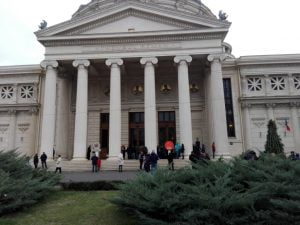
The circular shape of the building is due to the fact that the Romanian Athenaeum was erected, between 1886-1888, on the foundation erected for the construction of a circus. Galleron retained its original shape and designed a building in the form of a Greek temple, supported on six front and two side columns. The dome, which dominates the entire construction, gives it height and elegance. The interior of the Athenaeum is dominated by 12 columns, but also by four spiral marble stairs. The Athenaeum can host a thousand spectators in the concert hall where the acoustics are perfect.
The Romanian Athenaeum not only impresses with the grandeur of the construction. Equally spectacular is the fresco from the inside, made by the painter Costin Petrescu. However, the words are far too poor to evoke the beauty of these jewels we discover in Bucharest, so we invite you to go alone and follow Albert Galleron through Little Paris.

Author: Ștefania Enache
Photo: Corina Gheorghe